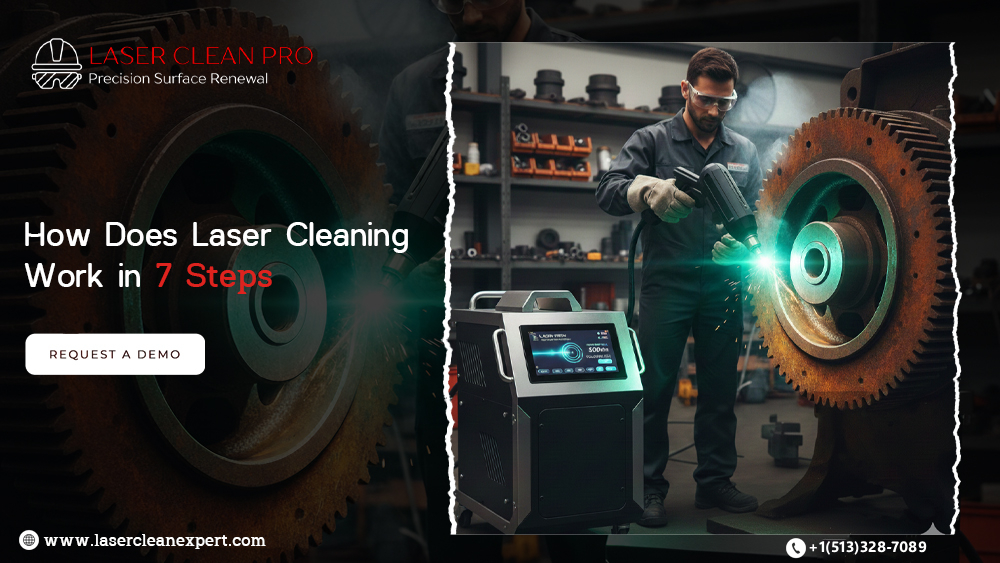
Laser rust removal works by directing concentrated laser energy at rust until the corrosion breaks apart and disappears. The rust absorbs the laser's energy, while the metal underneath reflects much of it. This allows laser rust removal to remove oxidation without grinding, blasting, or scraping away healthy material.
A rust removal laser targets the corrosion layer itself. When used correctly, it removes rust while preserving the underlying metal surface.
If you've watched a laser cleaning video, you've probably wondered whether the process is really as simple as it looks.
The answer is yes, but there is some science behind what you're seeing.
Rust and clean metal react differently to laser energy. Rust absorbs energy much more easily than the metal beneath it. When the laser hits the surface, the rust heats up rapidly and breaks apart. The clean metal reflects much of that energy and remains largely unaffected.
That difference is what makes laser cleaning rust possible without the abrasion associated with grinding wheels, sandblasting, or wire brushes.
Think about a rusted steel beam. Traditional methods remove corrosion by physically attacking the surface. A laser metal rust remover takes a different approach. Instead of scraping the rust away, it uses concentrated light energy to separate the corrosion from the metal underneath.
The process happens in three simple steps.
The laser beam is directed at the corroded area.
Rust absorbs the laser energy almost immediately because it requires less energy to break apart than clean steel. The laser stays focused on the corrosion layer rather than the base metal.
This targeted approach is what makes laser cleaning different from many traditional rust-removal methods.
As the rust absorbs energy, its temperature rises rapidly.
The corrosion breaks down into microscopic particles, gas, and dust. Extraction systems or vacuums often collect these particles during industrial cleaning operations.
This is why many operators describe the process as watching rust disappear in real time. The rust is not being scraped away. It is being converted into tiny particles and removed from the surface.
This is the most important part of the process.
The underlying metal reflects much of the laser energy. It also requires significantly more energy to remove material than rust does.
Because of that difference, operators can remove corrosion without aggressively removing healthy metal.
For industries where surface preservation matters, this is a major advantage. A rusted machine component, structural beam, or fabricated part can often be cleaned without changing its dimensions or surface profile.
Many people ask whether laser rust removers really work.
The answer is yes. Manufacturers, restoration professionals, maintenance teams, and service contractors use rust removal laser cleaning every day to prepare metal surfaces for welding, coating, painting, and refurbishment.
Not every laser rust cleaning machine is built for the same type of work.
The machine that makes sense for restoring automotive parts may not be the best choice for cleaning structural steel at an industrial facility.
Understanding the main categories can help you evaluate which system fits your application.
A pulse laser cleaning machine releases energy in short, controlled bursts.
These systems are often chosen for applications where precision matters more than raw cleaning speed.
Common applications include:
Because pulsed systems deliver energy in intervals, operators have greater control over how aggressively material is removed.
If your goal is to preserve surface details while removing oxidation, a pulsed system is often worth considering.
Continuous Wave, or CW, systems emit a constant stream of laser energy.
These machines are commonly used for:
CW systems often provide higher throughput on large surfaces, making them attractive for contractors and industrial operators who prioritize productivity.
Many businesses start with handheld systems because they offer flexibility.
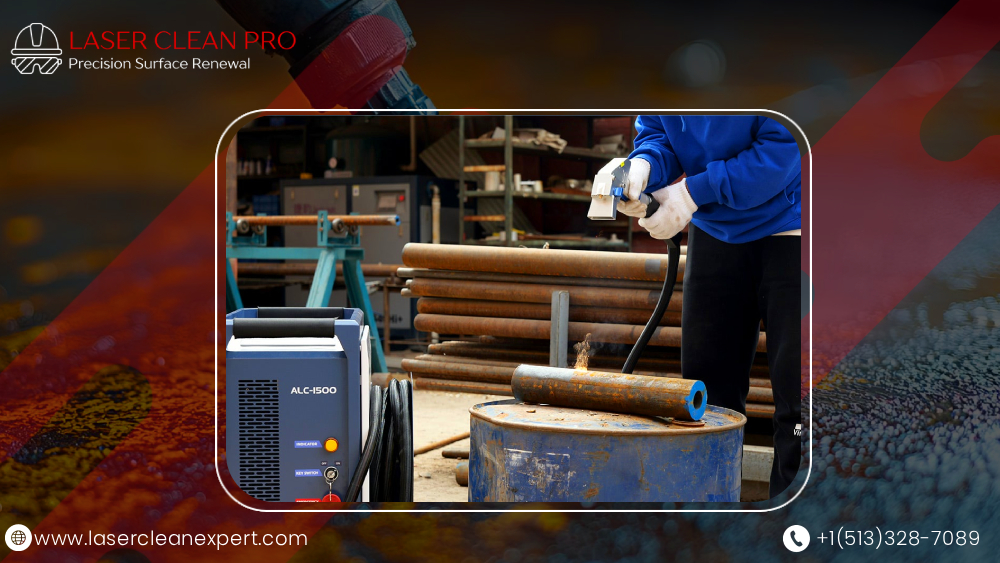
A rust removal laser gun allows you to bring the machine directly to the workpiece. That can be useful when cleaning equipment, structural components, or installations that cannot be moved easily.
Automated systems are typically used in manufacturing environments where the same cleaning process occurs repeatedly.
Today's laser cleaning machine market includes systems ranging from small portable units to industrial machines exceeding 3000 watts. The right choice depends on your workload, not simply the highest power rating available.
Laser cleaning works on a variety of metal surfaces, although settings often need to be adjusted depending on the material.
Steel is one of the most common materials cleaned with laser technology.
You'll find laser systems used on:
Many contractors remove rust with laser systems before welding or coating because the process leaves behind a clean surface without blasting media or chemical residue.
Cast iron and other iron-based materials frequently develop corrosion over time.
Laser cleaning can remove oxidation while preserving details that might be lost through aggressive grinding or sanding.
Aluminum does not rust like steel, but it does develop oxidation and contamination.
Laser cleaning can remove these surface layers when the correct settings are used.
Museums, restoration specialists, and preservation professionals often use laser cleaning on decorative and historic metal pieces.
The ability to target corrosion without aggressive abrasion makes the process useful for preserving valuable surfaces.
Yes, laser rust removal works extremely well for many metal cleaning applications.
That does not mean it is the perfect solution for every job.
Like any technology, it performs best when used in the right situations.
A laser cleaner rust remover is particularly effective when you need precision, surface preservation, and reduced cleanup. It works well on structural steel, industrial equipment, fabricated parts, and restoration projects where protecting the base material matters.
At the same time, it's important to have realistic expectations.
Laser cleaning is not magic.
The process may require multiple passes on heavily corroded surfaces. Some large, open areas may be cleaned faster using other methods. Operator training also plays an important role in achieving consistent results.
The goal should not be to force every cleaning challenge into one solution.
The goal is to choose the method that makes the most sense for the work in front of you.
Laser cleaning offers several advantages that are difficult to replicate with traditional methods.
It can:
These advantages explain why many industrial operators continue adopting laser technology for maintenance and surface preparation work.
Laser cleaning also has limitations.
Some of the most common include:
Understanding these limitations helps set realistic expectations and leads to better buying decisions.
In many situations, yes.
This is one of the reasons laser cleaning continues to gain traction across maintenance and refurbishment industries.
Traditional rust-removal methods often require extensive preparation. Equipment may need to be dismantled, moved, masked, or isolated before work can begin.
A handheld system allows operators to clean corrosion directly on installed equipment.
That can be useful for:
For businesses that deal with maintenance work regularly, reducing disassembly time can have a significant impact on productivity.
If you're interested in this topic, read our guide on Can You Remove Rust From Equipment Without Taking It Apart?
People searching for laser rust removal cost often expect a simple answer.
The reality is that several factors influence the overall investment.
Service costs vary based on:
Cleaning a lightly rusted component takes far less time than restoring heavily corroded industrial equipment.
If you're searching for local laser cleaning services, ask providers about expected cleaning outcomes, preparation requirements, and project timelines. Those factors often affect overall cost more than the cleaning method itself.
When evaluating equipment, the purchase decision should go beyond price alone.
Factors that influence value include:
Instead of focusing only on the initial investment, ask yourself:
Those answers are often more valuable than comparing specifications on a spreadsheet.
There is no single rust-removal method that works best in every situation.
Laser cleaning excels when you need precision, control, and surface preservation.
Chemical removers may make sense for occasional small-scale projects. Mechanical methods may still be useful in certain high-volume applications.
A laser to remove rust is often the preferred option when protecting the base material matters, but that doesn't automatically make it the right choice for every project.
The best solution depends on the material, the condition of the surface, and the outcome you're trying to achieve.
Choosing the right laser rust cleaning machine starts with understanding the type of work you perform
Before evaluating equipment, consider:
The answers will help narrow your options quickly.
Lower-power systems are often used for restoration, detailed cleaning, and precision applications. Higher-power systems are typically chosen for industrial maintenance, heavy corrosion, and larger surface areas.
You should also consider whether a pulsed or Continuous Wave system makes more sense for your workload.
Pulsed systems prioritize control.
Continuous Wave systems prioritize throughput.
Neither is universally better.
The right laser rust removal machine is the one that aligns with the work you perform every day.
Whether you're evaluating a laser cleaner rust system for restoration work or a high-power industrial setup, focus on applications first and specifications second.
Laser rust removal is a proven technology used across manufacturing, maintenance, restoration, and industrial cleaning.
It works by targeting corrosion while preserving the metal underneath. That makes it useful for surface preparation, equipment refurbishment, maintenance work, and rust removal on valuable components.
For businesses that regularly deal with corroded metal surfaces, a rust removing laser can improve cleaning quality while reducing reliance on abrasive methods.
For occasional projects or applications that fall outside the strengths of laser technology, another solution may be more practical.
The best results come from matching the technology to the job. Understanding how the process works is the first step toward making that decision with confidence.