A handheld laser cleaner for wood can remove paint, varnish, soot, mold, and other surface coatings without sanding or chemical strippers. Instead of grinding away the surface, it uses controlled laser pulses to remove unwanted material while helping preserve the wood underneath. That makes laser cleaning a practical option for furniture restoration, historic preservation, woodworking shops, and contractors expanding into specialty surface preparation. The results, however, depend on using the right type of laser. Wood is more sensitive than steel, so machine selection and operating settings matter just as much as the cleaning process itself. This guide explains how laser cleaning works on wood, where it performs well, where its limitations begin, and what to consider before investing in a machine
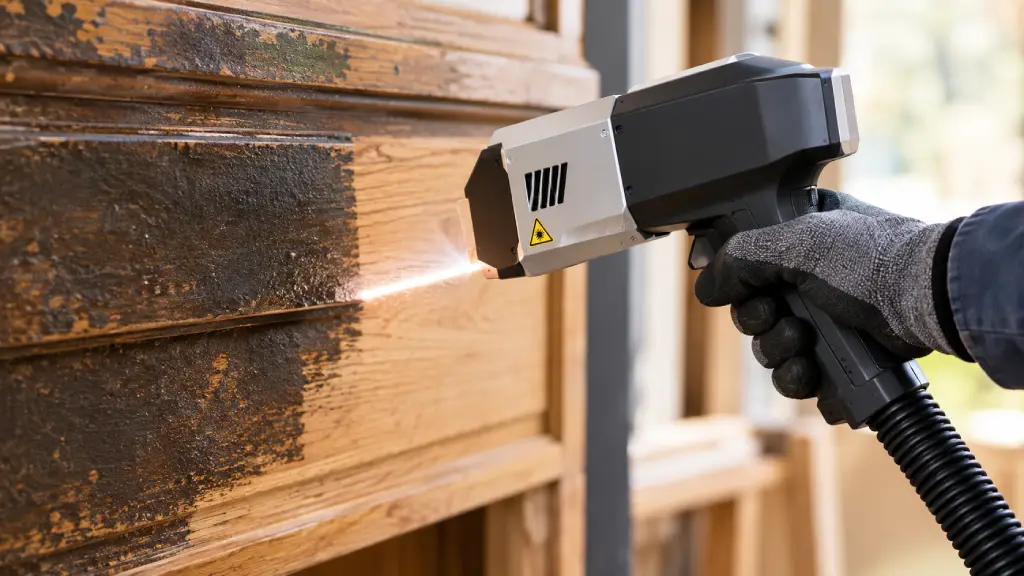
A handheld laser cleaner for wood is a portable laser cleaning system designed to remove coatings without physically touching the surface. Instead of sanding or blasting the material, the machine directs laser energy onto paint, varnish, soot, mold, or other contaminants. Those layers absorb the energy and separate from the wood underneath. For wood applications, pulsed laser cleaners are generally the preferred choice. They deliver short bursts of energy that give operators more control and reduce the risk of overheating the surface. The handheld design also makes it easier to clean furniture, doors, cabinets, exposed beams, and other large structures without taking them apart. For restoration companies and mobile contractors, that flexibility can create new service opportunities while reducing the need for abrasive media or chemical stripping products.
Laser cleaning works because coatings and wood respond differently to laser energy. When the laser reaches the surface, the paint, varnish, or stain absorbs far more energy than the wood beneath it. The coating heats up, breaks apart, and lifts away from the surface. Because the laser delivers energy in extremely short pulses, heat has less time to spread into the surrounding wood. That controlled process helps remove unwanted material while preserving the natural grain when the correct settings are used. Operators can adjust power, pulse frequency, scanning speed, and focus depending on the coating being removed and the condition of the wood. Older furniture with delicate carvings often requires lower settings than structural beams or large painted surfaces. The goal isn't to remove material as quickly as possible. The goal is to remove the coating while keeping the original wood in the best possible condition. That's one reason laser cleaning has become a popular option for restoration work where surface preservation is just as important as cleaning speed. For a restoration business, that control translates directly into fewer redos and higher-value jobs you can confidently take on.
One of the biggest buying decisions is choosing between a pulsed laser and a continuous wave (CW) laser. Although both use laser energy, they're designed for different types of work.
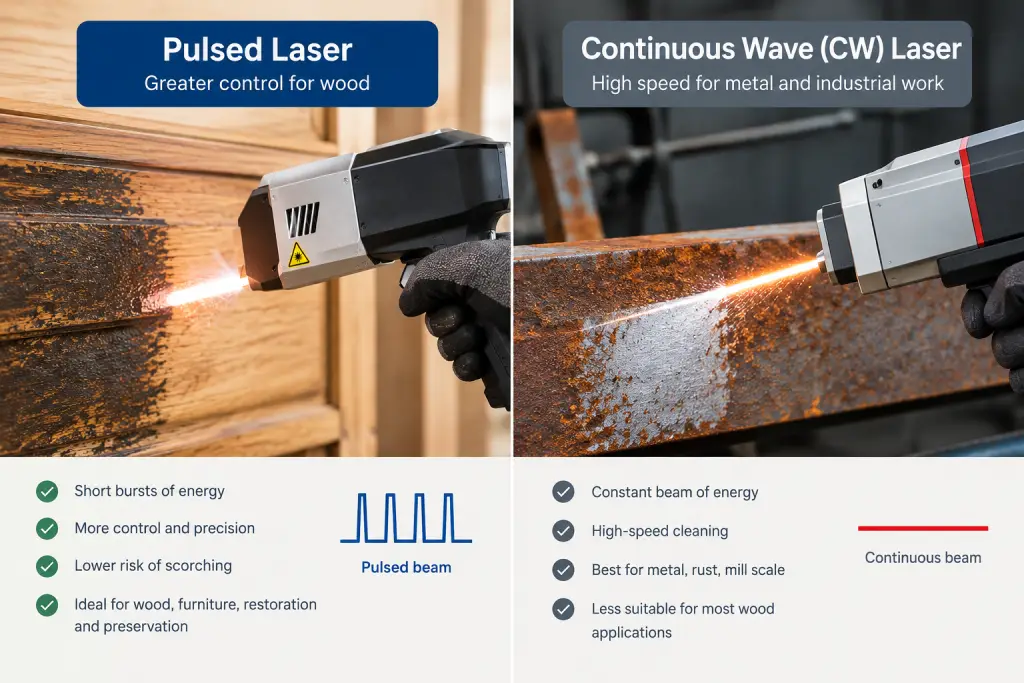
Pulsed lasers release energy in very short bursts instead of one continuous beam. That gives operators much greater control over how much energy reaches the surface at any moment. For wood, this precision is important. It allows coatings to be removed gradually while reducing the chance of scorching or damaging the material underneath. Pulsed systems are commonly used for furniture restoration, historic preservation, painted wood, decorative trim, cabinets, doors, and other projects where maintaining the original surface matters. They can also give restoration businesses more confidence when working on higher-value projects that require careful surface preparation.
Continuous wave lasers deliver a constant beam of energy. They're designed for high-speed cleaning on metal surfaces, heavy rust removal, mill scale, and industrial maintenance where productivity is often the priority. That same continuous energy makes them less suitable for most wood applications. Without careful control, the heat can scorch or burn the surface before the coating is fully removed. This doesn't make CW machines better or worse than pulsed systems. It simply means they're built for different jobs. If your business plans to focus on wood restoration, furniture refinishing, or architectural preservation, a pulsed laser is typically the better fit. If your primary work involves industrial metal cleaning and wood projects are only occasional, the machine choice becomes a broader business decision based on the services you want to offer
Before comparing power levels or machine features, think about the type of projects your business completes most often. A furniture restoration shop has very different requirements than a contractor cleaning structural timber or removing coatings during commercial renovations. Matching the machine to your workflow usually leads to better results than simply choosing the highest-powered option. That's also why machine specifications should support the buying decision, not drive it. In the next section, we'll look at the types of coatings laser cleaning removes well, where it struggles, and how those differences affect real restoration projects.
Laser cleaning works well on many of the coatings found in restoration and refinishing projects. The best results usually come when the coating absorbs laser energy more readily than the wood underneath. Not every finish behaves the same way, though. Understanding what a laser can and cannot remove helps set realistic expectations before investing in a machine. Knowing this upfront helps a business scope jobs accurately and set the right expectations with clients before quoting.
Laser cleaning is commonly used to remove paint, thin varnish, soot, smoke residue, mold, mildew stains, and old shellac from wood surfaces. These coatings typically respond well because they absorb laser energy more efficiently than the wood itself. Restoration companies use laser cleaning after fire damage to remove soot from exposed beams, timber framing, and decorative woodwork. Thin layers of paint and aged finishes are also good candidates. Instead of stripping the entire surface mechanically, operators can remove the coating while preserving fine details that might otherwise be lost. This is especially valuable when restoring antique furniture, carved moldings, or historic architectural features.
Some coatings are designed to resist heat, chemicals, and wear. Those same properties can make them more difficult for laser cleaning to remove efficiently. Examples include epoxy coatings, polyurethane finishes, powder coatings, and high-build industrial paints. These materials often require more energy, multiple passes, or a different removal method altogether. High-gloss UV-cured finishes can also be challenging because they reflect part of the laser energy instead of absorbing it. That doesn't always mean laser cleaning isn't an option. It simply means results depend on the coating, its thickness, and the condition of the surface. An honest assessment before starting a project can save time and help determine whether laser cleaning is the right approach.
Laser cleaning isn't limited to one type of project. Businesses use it across a wide range of restoration, maintenance, and surface preparation work. The right application depends on the condition of the wood and the finish being removed.
Furniture restoration is one of the most common uses for pulsed laser cleaning. Antique tables, chairs, cabinets, and decorative pieces often have detailed carvings that are difficult to clean with traditional methods. Sanding can round over sharp edges or remove fine details. Chemical strippers can be messy and require additional cleanup. Laser cleaning gives operators more control when removing old finishes while preserving intricate craftsmanship. For restoration businesses, that precision can become a valuable selling point when working on high-value furniture.
Removing paint from wood doors is often time-consuming. Corners, raised panels, and decorative trim usually require hours of manual scraping and sanding. A handheld laser cleaner allows operators to work directly on those detailed areas with greater precision. It can also reduce the amount of dust created during the stripping process. For contractors completing renovation work, this makes laser cleaning a practical option for both residential and commercial projects.
Cabinet refinishing presents many of the same challenges as furniture restoration. Multiple edges, profiles, and detailed joinery make traditional stripping methods labor-intensive. Laser cleaning allows operators to work around those features without constantly changing sanding tools or applying chemical removers. For businesses that specialize in kitchen or commercial cabinet refinishing, it can become another service that helps differentiate them from competitors.
Large timber beams often require cleaning during restoration or adaptive reuse projects. Paint, soot, weathering, and surface contamination can hide the original appearance of the wood. Laser cleaning gives contractors a way to restore these surfaces while producing less secondary waste than abrasive blasting. The portability of handheld systems also makes on-site work much easier than removing structural components for off-site restoration. For contractors working on barns, heritage buildings, or commercial renovations, this flexibility can reduce project time and transportation costs.
Historic buildings require careful restoration methods. Removing too much material can permanently change the appearance of original woodwork. Because pulsed laser systems are non-contact, they're commonly considered for projects where preserving the existing surface is the priority. Operators can clean decorative trim, exposed beams, staircases, and architectural details with greater precision than many traditional stripping methods. Every project is different, but laser cleaning offers restoration professionals another option when preservation matters more than speed.
Yes, but the laser isn't removing rust from the wood itself. It's removing rust from the metal hardware attached to the wood, such as hinges, brackets, fasteners, or decorative fittings.This can be useful during restoration projects where the goal is to clean both the wood and its original hardware without completely disassembling the piece. Instead of switching between different cleaning methods, contractors can often restore multiple materials using the same laser system with the appropriate settings. That added versatility can make laser cleaning more valuable for businesses handling furniture restoration, historic preservation, or architectural renovation.
Not every laser cleaning machine is designed for wood restoration. Choosing the right system starts with understanding the type of work your business plans to do. A machine that performs well in an industrial fabrication shop may not be the right fit for furniture restoration or architectural preservation. Here are the factors worth considering before investing.
The first decision is the type of laser. For wood, pulsed laser systems are generally the preferred choice because they deliver energy in short bursts. That gives operators greater control over the cleaning process and helps reduce the risk of damaging delicate surfaces. Continuous wave (CW) lasers are better suited to heavy-duty industrial cleaning on metal. While they excel at removing rust and mill scale, they aren't typically the first choice for detailed wood restoration. Choosing the right laser type from the beginning can save time, reduce rework, and help your business take on more specialized projects.
Higher power isn't always better. If your work focuses on antique furniture, decorative trim, or cabinetry, a lower-powered pulsed system often provides the control needed for detailed restoration. Businesses cleaning larger timber beams, painted structures, or commercial projects may benefit from higher-powered systems that cover more surface area in less time. Instead of asking, "What's the most powerful machine available?" ask, "What type of work do I complete every week?" That question usually leads to a better buying decision.
Wood restoration projects often happen on-site; historic buildings, built-in cabinetry, and large doors can't always be moved to a shop. A portable handheld system makes it easier to bring the machine to the job instead of transporting the project to the machine. For contractors offering mobile restoration services, portability can become an important competitive advantage.
Specifications matter, but they shouldn't be the only factor influencing your decision. Training, technical support, replacement parts, and application guidance all play a role in how quickly your business can start using the equipment productively. For companies entering laser cleaning for the first time, ongoing support is often just as valuable as the machine itself. The goal isn't simply to purchase equipment. It's to invest in a system that helps your business complete work efficiently and confidently.
Laser cleaning offers several advantages for wood restoration when the right equipment and settings are used.
Some of the most valuable benefits are practical rather than technical.
For many businesses, these advantages are less about replacing every existing process and more about adding another capability to their service offering.
Laser cleaning isn't the right solution for every wood restoration project. Knowing its limitations helps businesses choose the right jobs and set realistic expectations with customers. Some coatings simply don't respond well to laser cleaning. Heavy epoxy finishes, thick polyurethane coatings, and certain industrial paints may require multiple passes or an alternative removal method. Large flat surfaces can also take longer to clean than mechanical stripping or other high-production methods. The process requires operator training as well. Settings need to be adjusted for different wood species, coatings, and project conditions to achieve consistent results. Safety is another consideration. Laser cleaning requires appropriate eye protection and proper fume extraction to create a safe working environment. Understanding these tradeoffs allows businesses to decide where laser cleaning adds value and where another method may be more practical.
Yes. Pulsed laser cleaners can remove paint, varnish, soot, mold, and other surface contaminants from wood while helping preserve the underlying material when operated with the correct settings.
No. Thin paints, shellac, soot, and many varnishes respond well to laser cleaning. Thick epoxy coatings, polyurethane finishes, and some industrial coatings can be more difficult to remove efficiently.
It can be. Pulsed laser systems are commonly used for restoration because they provide greater control than many traditional stripping methods. The results still depend on proper machine settings and operator experience.
Not completely. Laser cleaning and sanding serve different purposes. Laser cleaning removes coatings and contaminants, while sanding is often used to prepare the surface before refinishing.
Many restoration projects benefit from using both methods together
Yes. Portable systems allow contractors to perform restoration work on-site, making them well suited for businesses that clean furniture, timber beams, doors, cabinets, or historic buildings at customer locations.
A handheld laser cleaner for wood can be an effective tool for restoration, refinishing, and specialty surface preparation. It offers a controlled, non-contact way to remove many common coatings while helping preserve the wood underneath. Like any professional equipment, success depends on choosing the right machine for the work you do. Businesses focused on furniture restoration or historic preservation often have different requirements than contractors handling large commercial projects or structural timber. Taking the time to understand those differences makes it easier to select equipment that fits your workflow, supports future growth, and delivers consistent results. If your business is evaluating laser cleaning for wood restoration, furniture refinishing, or architectural preservation work, talk to an Expert or Schedule a Demo to see how the technology performs on your typical projects.