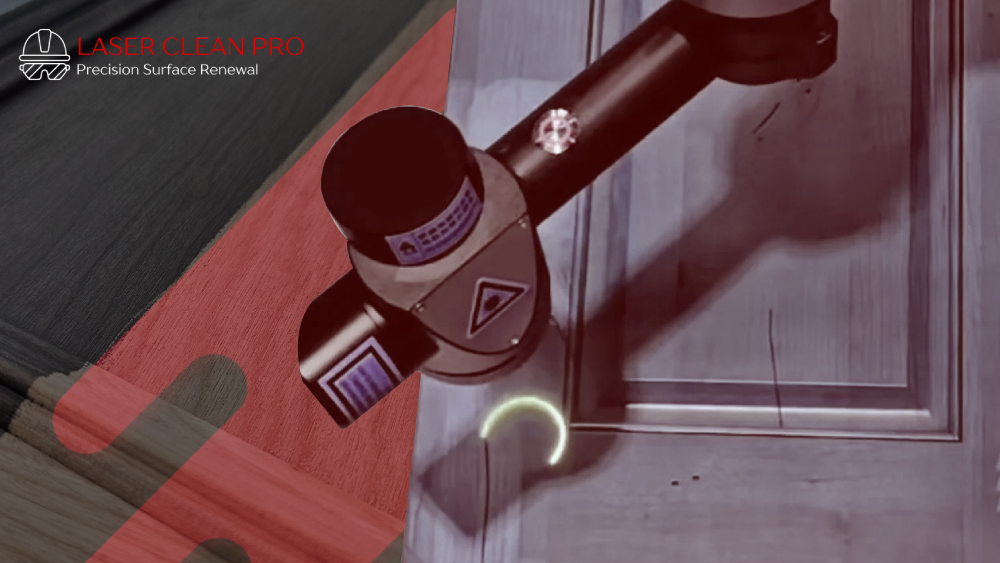
Yes, you can remove paint from wood with a laser. The process uses laser ablation to break down paint and coatings while preserving the wood underneath. Unlike sanding or chemical stripping, laser paint removal from wood does not rely on physical contact or harsh chemicals, making it a useful option for restoration work, carved surfaces, and detailed wood components.
The answer to how does laser stripping work comes down to how paint and wood respond to laser energy.
Paint absorbs laser energy more readily than the wood underneath. When the laser beam hits the painted surface, the coating heats up rapidly and breaks apart. The wood below absorbs less energy, allowing the coating to be removed while limiting damage to the underlying material.
Modern systems achieve this through short pulses of energy. These pulses deliver enough power to remove paint without allowing excessive heat to build up in the wood.
This matters because wood reacts differently than metal. A laser wood cleaning machine must balance cleaning power with heat control. Too much energy in one area can scorch the surface. Proper settings allow the paint to be removed while preserving grain patterns, carved details, and surface texture.
This process is often referred to as laser cleaning wood because it removes unwanted coatings without grinding away the material beneath them.
The result is a clean surface that is ready for restoration, refinishing, or inspection.
Not all coatings respond to laser removal in the same way.
Some absorb laser energy efficiently and come off quickly. Others require additional passes and more careful setup.
Laser removal typically works well on:
Dark coatings usually absorb more laser energy than lighter coatings. As a result, they often clean faster and require fewer passes.
Certain coatings can be more challenging.
These include:
These materials reflect more energy and may require slower processing speeds.
One distinction often gets overlooked.
Paint and stain are not the same thing.
Paint sits on the surface and forms a coating layer. A laser paint remover for wood removes that surface layer effectively.
Stain behaves differently because it penetrates into the wood fibers. Once stain becomes part of the wood itself, laser removal becomes less predictable. The surface may clean up, but traces of the stain can remain within the grain.
If you're evaluating a project, identifying the coating type is one of the first steps. It often determines whether a laser wood stripper is the right solution.
For detailed restoration work, laser wood stripping often produces better results than sanding.
For large flat surfaces where speed and budget matter most, sanding may still have an advantage.
The difference comes down to how each method removes paint.
Sanding removes both the paint and a small amount of wood. On a flat tabletop or a simple panel, that may not be a problem. On carved moldings, decorative trim, or antique furniture, material loss can remove details that cannot be restored.
Chemical stripping avoids abrasion but introduces other challenges. Cleanup takes time. Some products require multiple applications. Others leave residue behind or raise the wood grain.
A laser cleaning machine for wood removes coatings without physically touching the surface. That allows decorative details, sharp edges, and fine craftsmanship to remain intact.
This is why laser systems are often used on:
Laser stripping is not always the fastest option. Large flat surfaces can often be stripped more quickly with sanding equipment.
The question is not which method is universally better.
The question is which method fits the material you're working on.
If preserving detail is important, laser striping wood often delivers results that sanding cannot match.
Laser paint removal has advantages, but it also has limitations.
One challenge is heat management.
Incorrect settings or slow movement can scorch the wood surface. Operator training plays an important role in preventing this.
Equipment cost is another consideration.
A professional laser paint stripping machine wood setup costs significantly more than a sander or a chemical stripping kit.
Safety requirements also increase.
Paint removal creates fumes and airborne particles. Older coatings may contain hazardous substances that require extraction systems and proper respiratory protection.
Eye protection is mandatory. Laser-rated safety eyewear is not optional.
Speed can also become a factor.
When working on large, flat surfaces that do not require precision, sanding often removes paint faster.
Understanding these limitations helps determine when laser technology makes sense and when another approach may be more practical.
Choosing a machine involves more than comparing wattage.
The first consideration should be laser type.
For wood applications, pulsed lasers are generally preferred. A pulsed system delivers short bursts of energy, allowing greater control over heat and material removal.
Continuous Wave systems are commonly used for industrial metal applications, but wood restoration usually benefits from the precision of pulsed technology.
Power requirements depend on the type of work.
For furniture restoration, decorative trim, and detailed wood components, systems in the 200W to 500W range are often sufficient.
Higher-power systems may improve throughput in commercial environments, but more power does not automatically produce better results.
The next consideration is portability.
A handheld laser stripper for wood allows operators to move around furniture, doors, moldings, and architectural elements. Larger cabinet systems are more common in production settings where parts move through a controlled workflow.
Before purchasing a machine, ask suppliers to test your specific combination of:
The results can vary significantly depending on the material.
Not sure how power levels affect performance? Our guide on Should I Buy a 500W, 1500W, or 3000W Laser Cleaning Machine? breaks down how different wattages fit different applications.
For one-time projects, ownership may not make financial sense. Rental options or professional services can often provide a better return.
The best laser wood stripping machine is the one that matches your workload and the type of projects you perform regularly.
The cost depends on whether you're hiring a service provider or purchasing equipment.
For businesses considering ownership, entry-level systems typically require a significant upfront investment. Professional pulsed systems designed for restoration and commercial use cost more but offer greater control and productivity.
Service pricing varies based on:
For occasional projects, hiring a specialist is often more cost-effective than purchasing equipment.
For restoration businesses, furniture shops, and commercial operators performing this work regularly, ownership may provide a stronger return over time.
Many suppliers offer demonstrations before purchase. Seeing a machine perform on your specific material often provides more useful information than reviewing specifications alone.
Laser paint removal requires proper safety procedures.
Start with eye protection.
Laser-rated goggles designed for the machine's wavelength are essential. Standard safety glasses do not provide adequate protection.
Ventilation is equally important.
Removing paint creates fumes and airborne particles that should not be inhaled. Use a fume extraction system and appropriate respiratory protection.
Keep the work area clear of flammable materials.
Wood is combustible. Paint dust can also create hazards in enclosed environments.
Never leave the beam stationary on one area for extended periods. Continuous exposure increases the risk of scorching and surface damage.
Safe operation protects both the operator and the material being restored.
The easiest method depends on the project.
For large flat surfaces, a heat gun can remove paint quickly and at a relatively low cost. The downside is reduced precision and a greater risk of damaging details.
Chemical strippers require little equipment but often create messy cleanup and longer project timelines.
Sanding works well on flat surfaces and remains one of the fastest removal methods available. However, it removes wood along with the paint and can erase fine details.
Laser removal occupies a different position.
It is not necessarily the easiest method. It is often the most precise.
When the goal is preserving craftsmanship, restoring architectural features, or cleaning intricate wood surfaces, laser technology offers advantages that traditional methods struggle to match.
That is why restoration professionals increasingly use laser systems on projects where preserving the original surface matters.
Laser paint removal works exceptionally well for restoration projects, detailed woodwork, carved surfaces, and applications where preserving the underlying material matters.
A laser cleaning machine for wood can remove paint without sanding away craftsmanship that may have taken years to create.
The technology may not be the right choice for every project. A flat door, a tight budget, or a one-time DIY job may be better served by traditional methods.
For restoration professionals, specialty contractors, and businesses that regularly work with detailed wood surfaces, a laser paint removal tool can provide a level of precision that sanding and chemical stripping cannot achieve.
The best way to evaluate whether it fits your work is to test the process on the actual wood and coating combination you encounter most often.