At some point, everyone serious about laser cleaning runs into the same question: what power level do I actually need?
It sounds like a straightforward spec comparison. In practice, it's one of the more consequential decisions you'll make when evaluating a laser cleaning machine for sale, because the wrong choice doesn't just affect how fast you work. It affects the kind of jobs you can take, how you operate in the field, and whether the machine pays for itself on your actual job profile rather than a hypothetical one.
This isn't a bigger-is-better decision. It's a fit decision. And to make it well, you need to understand what actually changes as power increases, not just in watts, but in beam behavior, ablation dynamics,and practical capability.
Wattage in a laser cleaning system is a measure of average output power, but what drives the cleaning process is more specific than that. Pulsed fiber lasers, which are the standard for rust and coating removal, deliver energy in discrete pulses rather than a continuous beam. The relevant parameters are pulse energy (the energy delivered per pulse), peak power (the instantaneous power during the pulse), repetition rate (pulses per second), and pulse duration.
Higher average power gives you more energy per unit time, which translates to faster surface coverage. But it also changes how aggressively the system interacts with the material. At higher pulse energies,the ablation process becomes more forceful. More material is removed per pass, and the thermal and mechanical effects on the substrate increase. This is useful when you're dealing with thick rust scale or heavy mill scale on structural steel. It requires more attention when you're working on thinner material,heat-sensitive components, or surfaces where dimensional tolerance matters.
The relationship between power and surface temperature is also worth understanding. Even though pulsed laser cleaning is significantly cleaner thermally than continuous-wave systems, higher power settings introduce more cumulative heat into the work zone over time. On assemblies with rubber seals, wiring, or bonded components nearby, that matters. Cooling between passes and appropriate standoff distances become more important as power increases.
Scan speed and spot size interact with power as well.Running a high-power system too slowly over a surface concentrates energy and risks affecting the substrate. Running it too fast at lower power leaves contamination behind. Getting the parameters right for a given material and rust condition is part of the operational knowledge that develops with time on the machine.
A 500W system sits at the entry point of serious commercial laser cleaning, and for certain applications, it's not entry-level at all. It's exactly right.
The lower pulse energy at this tier makes it well suited for surfaces where control matters more than speed. Automotive restoration is a clear example. Rust removal on body panels, frame sections,and detailed components requires a system that can work close to edges, around trim lines, and on varying metal thicknesses without introducing heat distortion or affecting surrounding finishes. A 500W portable laser cleaning machine handles this work in a way that higher-power systems don't always allow without careful parameter management.
Weld cleaning is another natural fit. Post-wel doxidation, heat tint, and spatter on stainless steel and carbon steel respond well to lower-power laser treatment, and the precision available at this tier makes it practical to clean close to finished surfaces without affecting them.Fabrication shops that do weld finishing regularly find 500W systems valuable for exactly this reason.
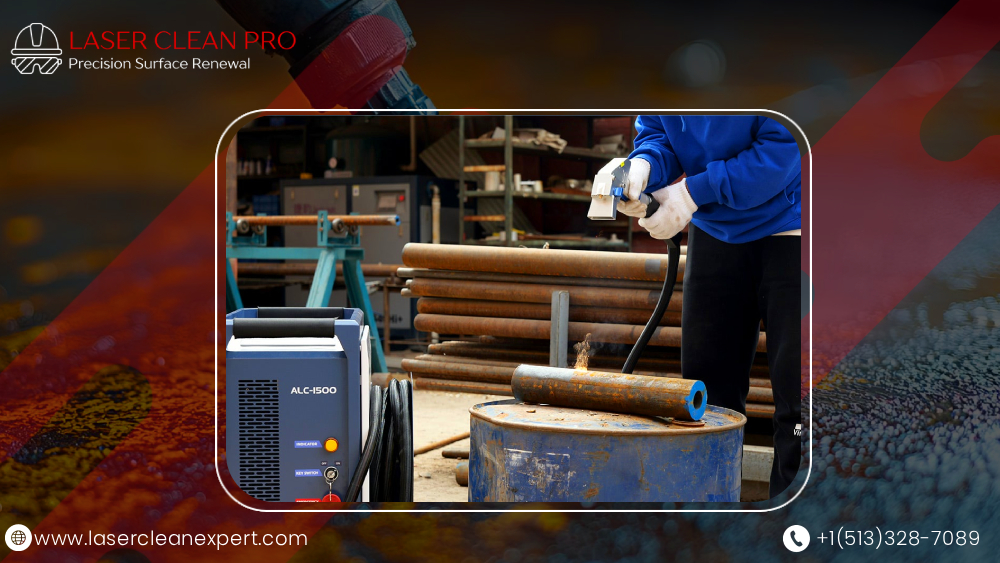
The portability factor is also more favorable at this power level. Lower-power systems are generally lighter, draw less from sitepower supplies, and are easier to move between locations. For operators running a portable laser cleaning machine across multiple job sites with varying access conditions, that matters operationally. You're not managing a system that requires a dedicated supply or significant setup time at each location.
Where 500W runs into its limits is on heavy rust scale,large surface areas, and any application where throughput is the primary concern.Thick laminar rust on structural steel, heavily corroded industrial components,and large surface prep jobs will require significantly more passes at this power level, and the time difference compared to a 1500W system becomes meaningful on volume work.
For most service businesses evaluating a laser rust removal machine for sale, 1500W is where the decision lands, and the reasoning is straightforward. It handles the widest range of real-world job conditions without the operational overhead that comes with higher-power systems.
At 1500W, pulse energy is high enough to address moderate to heavy rust efficiently, including the kind of layered oxidation that builds up on fleet equipment, structural components, and industrial machinery over years of outdoor exposure. Surface prep work for coating and welding, which requires not just rust removal but a consistently clean and slightly profiled surface, is well within this system's capability. The balance between ablation rate and thermal control is more forgiving than at 3000W, which gives operators more margin when working across varied material thicknesses and conditions in the field.
In terms of industry applications, 1500W systems are common in fleet maintenance operations where trucks, trailers, and heavy equipment need corrosion treatment on frames, under bodies, and mounting hardware. They're used in general industrial maintenance where rust develops on machine bases, structural supports, and connection points that need to be treated in place. Contract surface preparation businesses that work across amix of job types, some detailed, some larger scale, find the versatility at this tier more valuable than the raw speed of a 3000W system.
The portability trade-off is moderate. A 1500W portable laser cleaning machine is heavier and draws more power than a 500W unit, but it remains mobile enough for on-site work. Many operators at this tier run the system from a service vehicle with generator power, which is a practical and common setup for mobile service operations.
The honest limitation is throughput on very large surface areas. If your primary work involves cleaning large sections of structural steel, ship hull sections, or industrial flooring, 1500W will get there but more slowly than a higher-power system. For businesses where that kind of volume is the consistent reality, it's worth evaluating 3000W seriously.
A 3000W system is a different category of tool, not just a faster version of the lower-power tiers. The higher pulse energy changes the ablation dynamic in a meaningful way. Heavy rust scale, thick mill scale,and multi-layer industrial coatings that require multiple passes at 1500W can often be addressed in a single pass at 3000W. Over large surface areas, that difference compounds quickly into significant time savings per job.
The industries where 3000W makes genuine operational sense are those where surface area is large, contamination is heavy, and throughput is the primary constraint. Shipbuilding and ship repair are strong examples. Hull cleaning, structural section prep, and tank interior treatment involve large, heavily corroded surfaces where the speed advantage at 3000W translates directly into reduced labor hours. Offshore and energy infrastructure, including pipeline sections, structural steel on platforms, and large pressure vessels, falls into the same category.
Heavy industrial manufacturing at scale is another application where 3000W is genuinely justified. Prep work on structural steel sections, I-beams, and plate material before welding or coating requires consistent surface cleanliness across large areas, and the throughput available at this tier makes it economically viable in a way that lower-power systems can't match on volume.
The considerations at 3000W are worth being direct about. These systems require more stable power supply infrastructure, generate more fume and particulate per unit time (which means extraction capacity needs to keep pace), and demand more operator familiarity to manage parameters correctly across varying conditions. They're also less practical as portable laser cleaning machines for mobile service work. The weight, power requirements, and cooling demands make them better suited to fixed or semi-fixed installations than to operators moving between job sites regularly.
If your work doesn't consistently involve the kind of volume and contamination severity that justifies 3000W, the additional investment doesn't pay back in proportion to the cost. This is the most common miscalibration buyers make: choosing 3000W because it's the highest-spec option, then running it on job profiles that a 1500W system would handle just as well.
The most practical way to approach this is to audit your actual job history before evaluating any laser cleaning machine for sale.
Look at what you've worked on over the past year. What proportion of your jobs involved light to moderate rust versus heavy scale? How much of your work is detail-heavy versus surface-heavy? Are you primarily on-site or shop-based? Is throughput your main constraint, or is access and precision more often the limiting factor?
If most of your work is precision-oriented, involves mixed material thicknesses, or requires a genuinely portable setup, 500W is a serious option, not a compromise. If you're doing commercial service work across a broad range of applications and want a system that handles the majority of what comes through the door, 1500W is where most operators in that position end up. If your core work involves heavy industrial surface prep at scale, and your job volume justifies it, 3000W is the right tool.
The machines at all three tiers are capable and commercially proven. The difference isn't quality. It's what each one is designed to do well. Choosing based on your actual work profile rather than the spec sheet is what makes the investment perform the way you need it to.