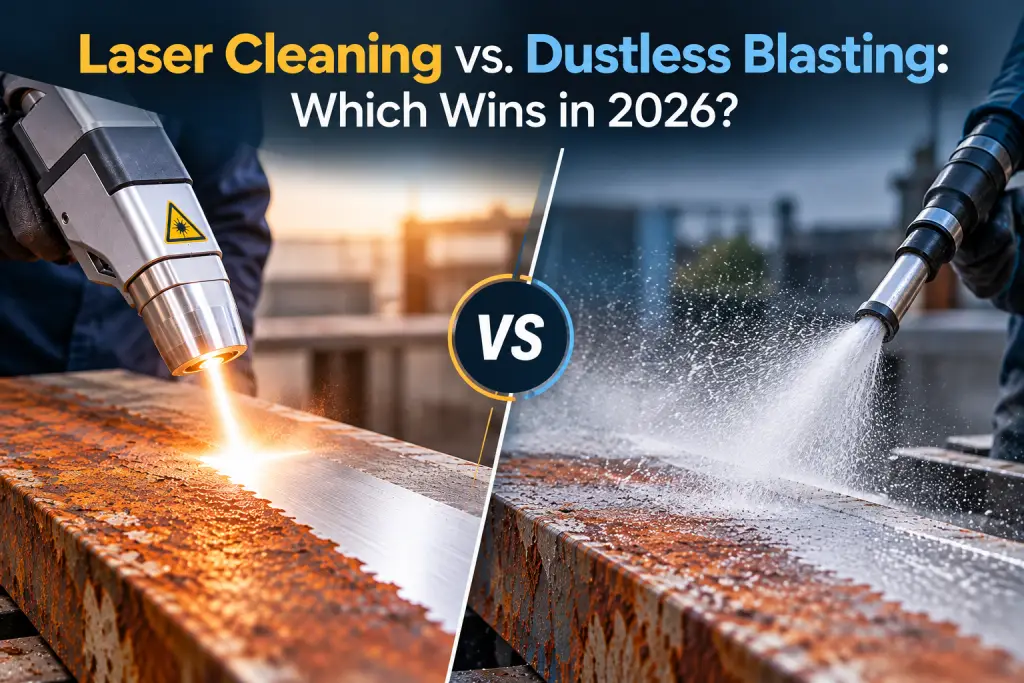
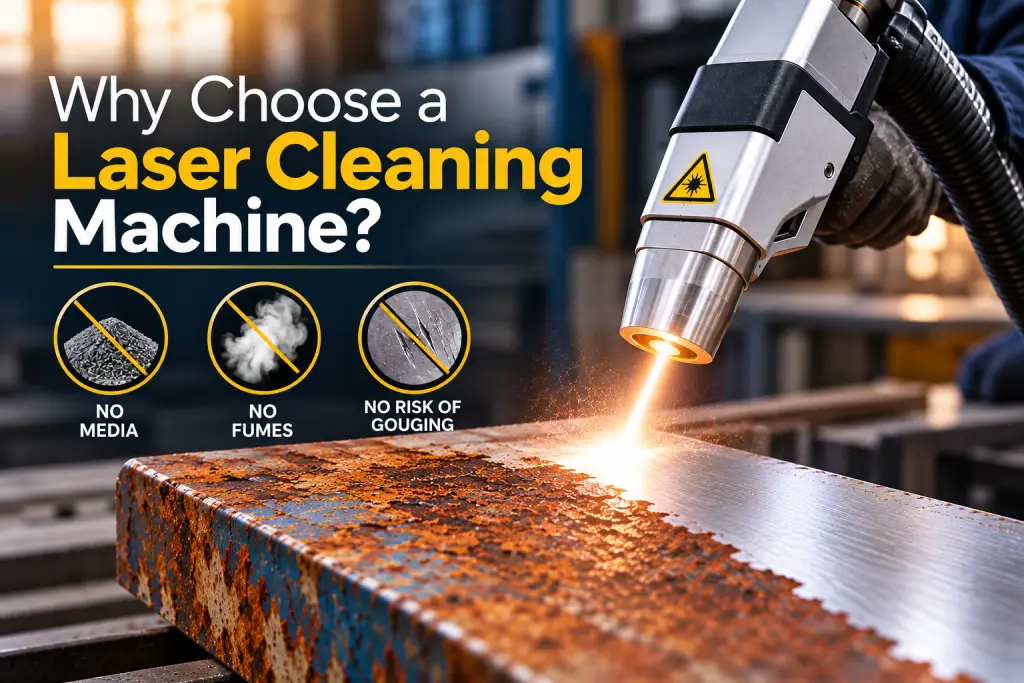
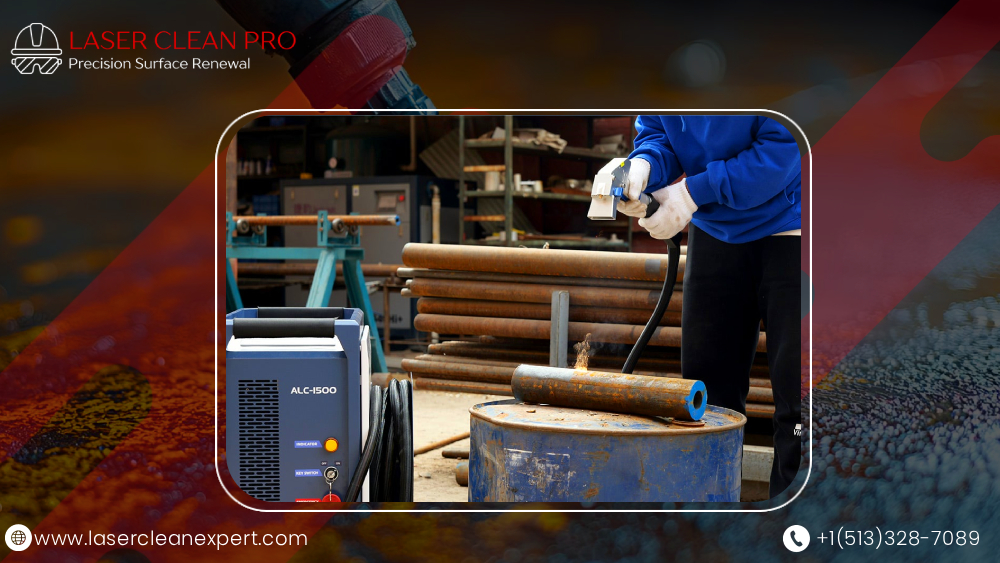
If you have watched laser cleaning videos online, it is easy to see why people get excited. Rust disappears. Paint lifts cleanly. The surface underneath looks untouched. It feels almost effortless.
That reaction makes sense because those videos are rewarding to watch, yet they omit a critical reality. The beauty of laser cleaning is that it is highly precise, being able to be controlled, and control is only possible when you get the machine, the surface and the settings to resonate with each other. In the absence of that, things may end up going astray more rapidly than anticipated by most individuals.
This article is not here to discourage anyone. It is here to make the learning curve clearer and a lot less frustrating.
When a professional with field experience comes to work, he or she will not begin to search for the correct button. The first thing they do is to scope the surface. They enquire, what is the base material? and how does it respond to heat? Steel, aluminum, stainless, cast parts, they are all different. And that is more than most people know.
They look closely at what needs to be removed. Light surface rust behaves very differently from scale. Old paint reacts differently than fresh coatings. Oil, carbon, and oxides each respond to energy in their own way.
They even visualize the end game when they have not turned a single crank. A trace of change of color is pleasant on a few occupations. On others there is not a mark of a good. It is one call that lays down the entire playbook. This silent assessment does not appear in the short vids, and this is where success begins.
A common misunderstanding is thinking of laser settings as a list of independent choices. Turn the power up. Slow the scan down. Make the beam wider. Clean faster. In reality, every adjustment affects something else. More power adds heat. Slower movement increases energy buildup. A wider scan spreads energy thinner. A tighter focus concentrates it.
This is why two people can use the same pulse laser cleaning machine and walk away with very different results. One gets clean, even removal. The other ends up with discoloration, slow progress, or uneven finishes. The difference is not talent. It is awareness of how changes ripple through the system.
Many newcomers are euphoric when their initial few tests succeed. The surface wipes clean. All looks good. But the bumps show up later. Heat builds up in long runs. Finishes are different on the same part. Edges do not respond in the same way as flat spots. What tacked an experimental part may lessen mid-way of a work.
It is at this point where experience counts. Experienced operators sense any changes and adjust before it is too late. Novices can only learn subsequent to a failure. Such a mismatch is why laser cleaning appears easy on the internet and more challenging in practice.
People often talk about pulse systems and Continuous Wave systems as if one is better than the other. In practice, they serve different kinds of work. A pulse laser cleaning machine gives fine control and is well suited for selective removal and sensitive surfaces. Continuous Wave systems offer steady output that works well for larger areas and consistent coverage.
Trouble starts when expectations are mismatched. When someone expects one mode to behave like the other, frustration follows. This is why guidance matters as much as hardware. The wrong expectation causes more problems than the wrong setting.
Laser cleaning is not meant to replace every surface preparation method. It excels in situations where control and cleanliness matter.
It works especially well when:
Service providers who understand this do not sell laser cleaning as a cheap alternative. They position it as a smarter one.
There are loads of machines up for grabs and tons of listings for a laser cleaning machine for sale. What is less readily available is clear instructions on the behaviour of those machines when they are not under perfect conditions.
That is the reason why other people purchase equipment that performs as the claim but remain disappointed. It is not a matter of performance. It’s expectations. Laser Clean Pro has built its approach around closing that gap. It is not only about the provision of the gear, but also about assisting the operators in knowing how the technology is applied in the real jobs, and to the real surfaces, and real business objectives.
Laser cleaning is not complicated, but requires consideration. When you understand the behavior of materials, the behavior of environments pushing and pulling each other, and the way the conditions change with time, the process can become predictable and gratifying. Forget about that knowledge and the machine appears unreliable.
The videos show the end result. Life on the job is found in the decisions made prior to drawing the trigger. And when such decisions work, laser cleaning is not only fun to observe, but solid-like to operate.