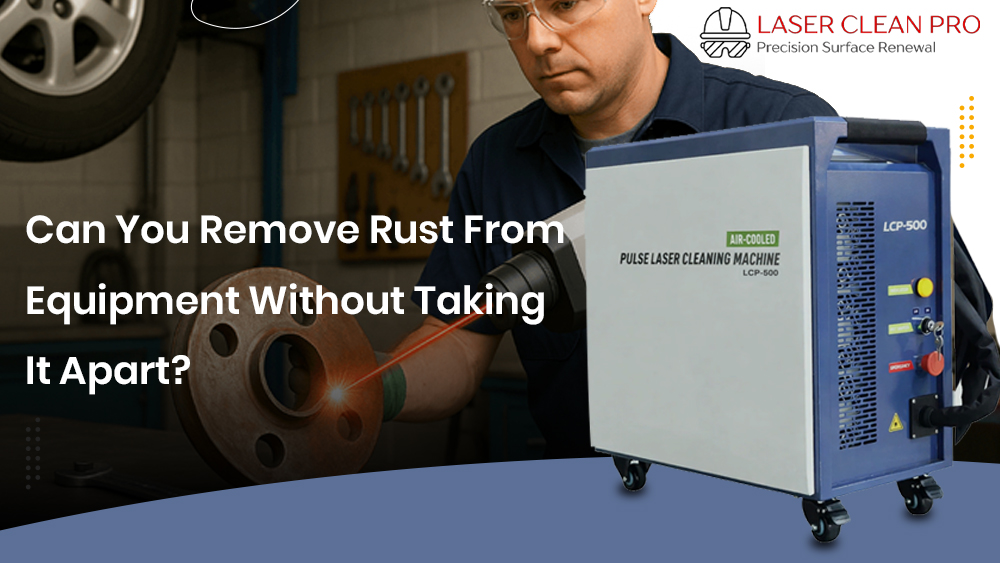
If you work on heavy equipment, you already know the real cost of rust isn't the rust itself. It's the hours that go into managing everything around it. Before you can even start, you're loosening bolts you'd rather leave alone, disconnecting components that took time to align, and setting up containment for whatever method you're about to use. By the time you're done reassembling everything, you've spent more time on logistics than on the actual problem.
That pattern holds across industries, from industrial maintenance to fleet service to marine operations. And it's the reason operators keep looking for a better way.
Conventional rust removal techniques weren't designed with assembled equipment in mind.
Grinding requires direct contact and unobstructed working space. It's effective on flat, accessible surfaces, but the moment you're working around a fastener, near a seal, or inside a recessed housing,the geometry works against you. You're either disassembling to get access or accepting an incomplete result.
Sandblasting introduces a different problem. Abrasive media spreads into every gap it can find; bearings, seals, electrical connections, hydraulic fittings. Protecting those areas requires masking and containment that often takes longer to set up than the blasting itself. On complex assemblies, it frequently isn't practical at all without partial tear down.
Chemical treatments are often underestimated as a source of problems. Rust converters and phosphoric acid-based products don't stay where you apply them. They migrate into joints, under seals, and along fastener threads, where residual acidity can accelerate corrosion in areas you weren't treating. Neutralizing and rinsing thoroughly enough to prevent this requires access you often don't have on assembled equipment.
The result is that disassembly becomes the default, not because it's the most efficient path, but because most methods leave you no other viable option.
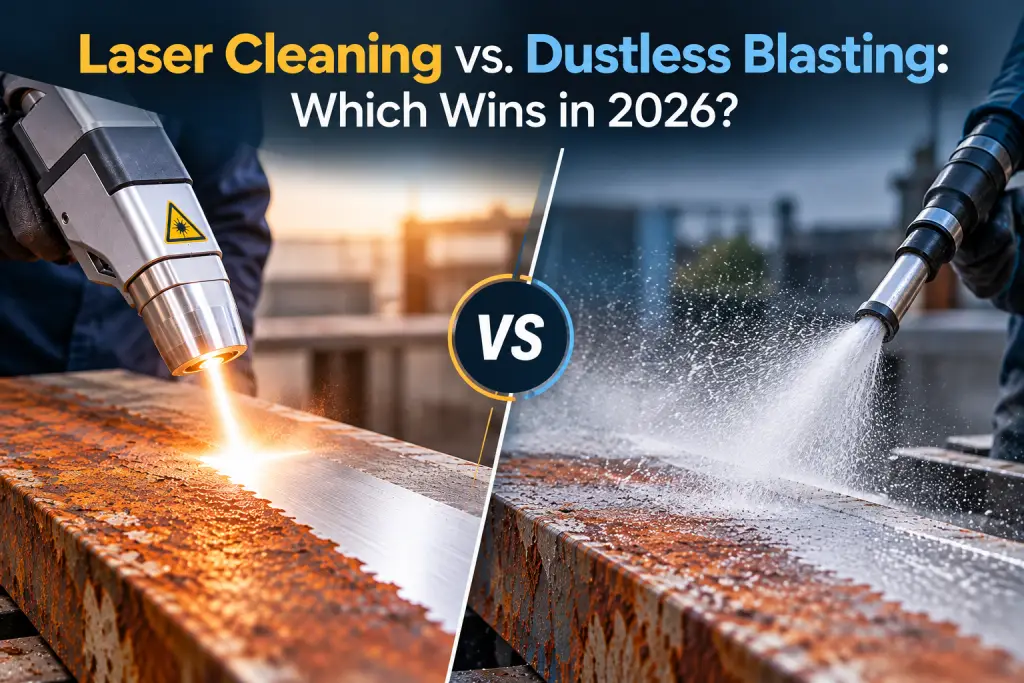
A laser rust cleaner operates on a fundamentally different principle than any of the methods above.
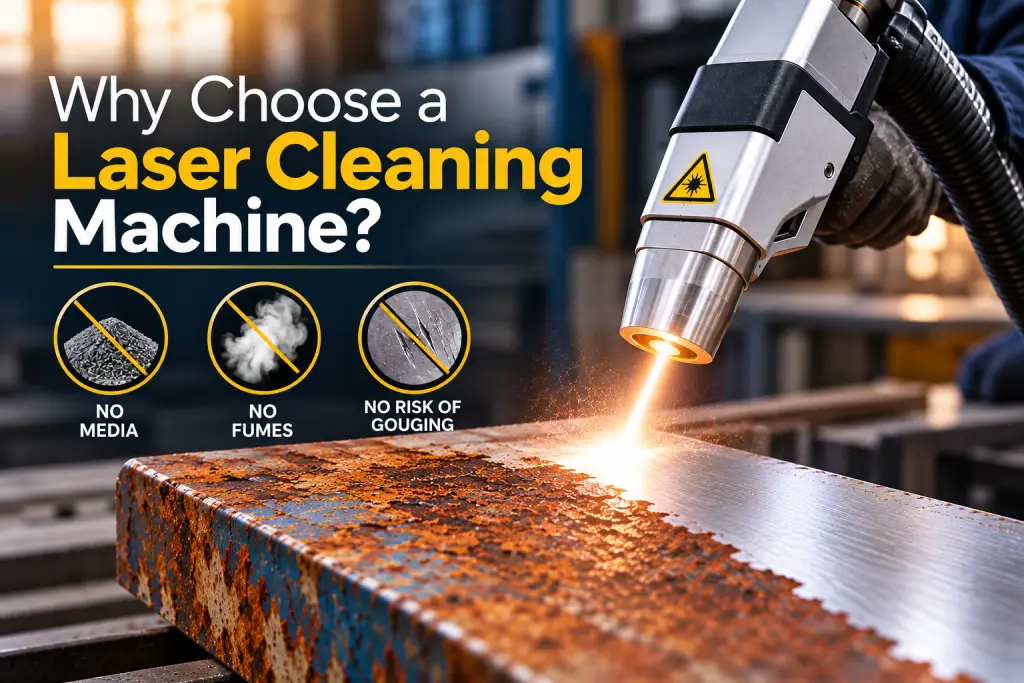
The process is called laser ablation. A pulsed laser beam is directed at the contaminated surface, and the rust, scale, or oxidation layer absorbs the laser energy rapidly enough to be vaporized or converted to fine particulate. The underlying base metal behaves differently: it has a higher reflectivity and thermal conductivity, which means it absorbs less energy and dissipates heat faster. When the system is correctly configured for the material and contamination type, the laser removes the surface layer with a selectivity that mechanical and chemical methods can't replicate.
The key variables are pulse duration, peak power,repetition rate, and wavelength. Fiber lasers operating in the infrared range(typically around 1064 nm) are the most common configuration for rust removalon steel and iron. Shorter pulse durations in the nanosecond range minimize heat transfer into the substrate, which matters when you're working near heat-sensitive components or thin-walled sections.
Power level determines how aggressively the system removes material and how quickly it can work across a given area. Lower-power systems in the 50 to 100 watt range are well suited for precision work and delicate surfaces. Higher-power systems from 200 watts upward cover more areaper pass and handle heavier oxidation and scale, but they require more operator attention to avoid affecting the substrate.
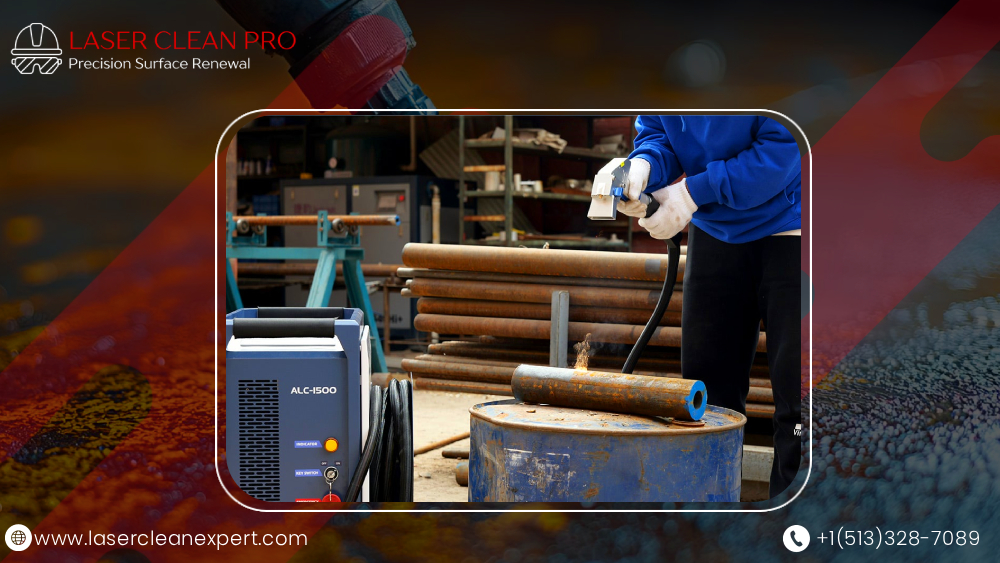
Because the process is non-contact and introduces no media or chemicals into the work area, a hand held laser rust remover can be used directly on assembled equipment in ways that other methods simply cannot.You can work around fasteners, along weld seams, inside partial enclosures, and adjacent to sensitive components without disturbing the surrounding structure.
The advantages of laser cleaning show up differently depending on the sector, but the underlying problem is consistent: rust develops in places that are inconvenient to access and costly to disassemble.
In manufacturing environments, rust accumulates on machine frames, press beds, fixture plates, and conveyor components. Many of these are bolted-down or integrated into production lines where taking them offline for disassembly means stopping output. A laser rust cleaner allows maintenance teams to treat corrosion in place during scheduled downtime,without the additional time cost of pulling and reinstalling components. It's also useful for preparing surfaces on tooling and molds, where dimensional accuracy matters and abrasive methods carry too much risk of material removal.
Frames, under bodies, cross members, and mounting points on trucks, trailers, and construction equipment are among the most rust-prone surfaces in any fleet operation. They're also areas where disassembly carries real risk: disturbing torque specifications on structural fasteners, misaligning mounting surfaces, or introducing contamination into sealed systems can create problems that outlast the rust you were trying to fix. A hand held laser rust remover lets operators treat these surfaces in place, which is faster and eliminates those secondary risks entirely.
Salt air and standing water create corrosion conditions that are significantly more aggressive than most land-based environments. On vessels and offshore structures, rust develops on hull sections, deck fittings,through-hull connections, and structural framework, often in areas with limited access and no practical way to bring equipment ashore for treatment. Laser cleaning is one of the few methods that can be used effectively in these conditions without generating the chemical waste or abrasive runoff that creates compliance issues in marine environments.
Rail equipment presents specific challenges because of the complexity of the assemblies involved. Bogies, brake components, and underframe sections accumulate rust in areas that are difficult to reach and dangerous to disassemble in the field. Structural elements on bridges and rail infrastructure face similar constraints. Laser cleaning allows targeted treatment without the broad surface disruption that sandblasting creates, which is important when you're working on load-bearing components where surface integrity matters.
Pipelines, valves, flanges, and pressure vessels develop rust at connections, welds, and support points. In these environments, the concern isn't just efficiency; it's the risk that aggressive rust removal methods will affect seals or introduce contamination into systems that carry hazardous materials. Laser cleaning's precision and the fact that it generates no secondary contamination makes it a practical option in environments where chemical treatments and abrasive blasting create compliance and safety problems.
Laser cleaning is a significantly safer working environment than sandblasting or chemical rust removal in several respects, but it isn't a method you operate without understanding the hazards involved.
Hand held laser rust removers used for industrial rust removal are Class 4 laser systems. Direct or reflected beam exposure to the eyes or skin at these power levels causes injury rapidly. Proper laser safety eye wear rated for the specific wavelength and power output of the system in use is mandatory, not optional. This is not standard UV-protective eye wear; it needs to be wavelength-specific optical density rated for the system's output.
Working areas should be clearly marked as laser hazar dzones, and bystanders should not be in the area without appropriate protection.Reflective surfaces near the work area require attention because they can redirect beam energy unpredictably. Most operators mark or mask polished surfaces adjacent to the work zone before starting.
The ablation process generates a plume of vaporized material and fine particulate that includes metal oxides and, on older equipment, potentially lead-containing paint residue or other hazardous coatings. Local exhaust ventilation or a fume extraction unit positioned at the work area is standard practice. Operators working without adequate extraction should be in appropriate respiratory protection for the specific contaminants involved. Before starting on any surface with unknown coating history, it's worth knowing what you're burning off.
Not every material in the work area behaves the same way under laser exposure. Rubber seals, wiring insulation, certain adhesives,and some coatings absorb laser energy very differently than steel. Knowing what's adjacent to your work zone before you start is basic preparation. In practice,this means a visual inspection and, on unfamiliar equipment, consulting service documentation to identify what's behind or beside the surface you're treating.
The technical variables involved in laser cleaning;power, pulse rate, scan speed, standoff distance; all affect the result.Running too slow at too high a power level can heat the substrate enough to cause distortion or affect heat-treated surfaces. Running too fast or at insufficient power leaves rust behind. Getting parameters right for a given application takes familiarity with the equipment and some time working with the system on representative material before moving to production work.
Most reputable laser cleaning equipment suppliers provide operator training as part of the purchase, and it's worth taking seriously. The learning curve isn't steep, but the consequences of getting it wrong; either damaging a component or failing to remove corrosion adequately;are real.
The upfront rust removal laser cost varies considerably depending on power level and system configuration, and it warrants careful evaluation. But the more operationally relevant question is what a laser cleaning system does to cost per job over time.
For service operations, the calculation involves labor hours saved per job, reduced consumable costs compared to abrasive and chemical methods, and the ability to take on work that isn't viable with conventional approaches. Fixed-head systems have their place in high-volume production environments, but for service operations working across varied equipment types and job conditions, a hand held laser rust remover offers flexibility that changes the range of work you can realistically quote.
Yes, you can remove rust from assembled equipment without taking it apart. But the more useful way to think about it is that laser cleaning gives you back a choice that most conventional methods remove.
The question was never really whether rust could be removed. It's whether it can be removed in the conditions you're actually working in, without creating a larger job around the one you started with,without secondary damage to adjacent components, and without the kind of setup and cleanup overhead that makes straightforward jobs expensive. That's where a laser rust cleaner earns its place, not just as a faster tool, but as agenuinely different way to approach the work.