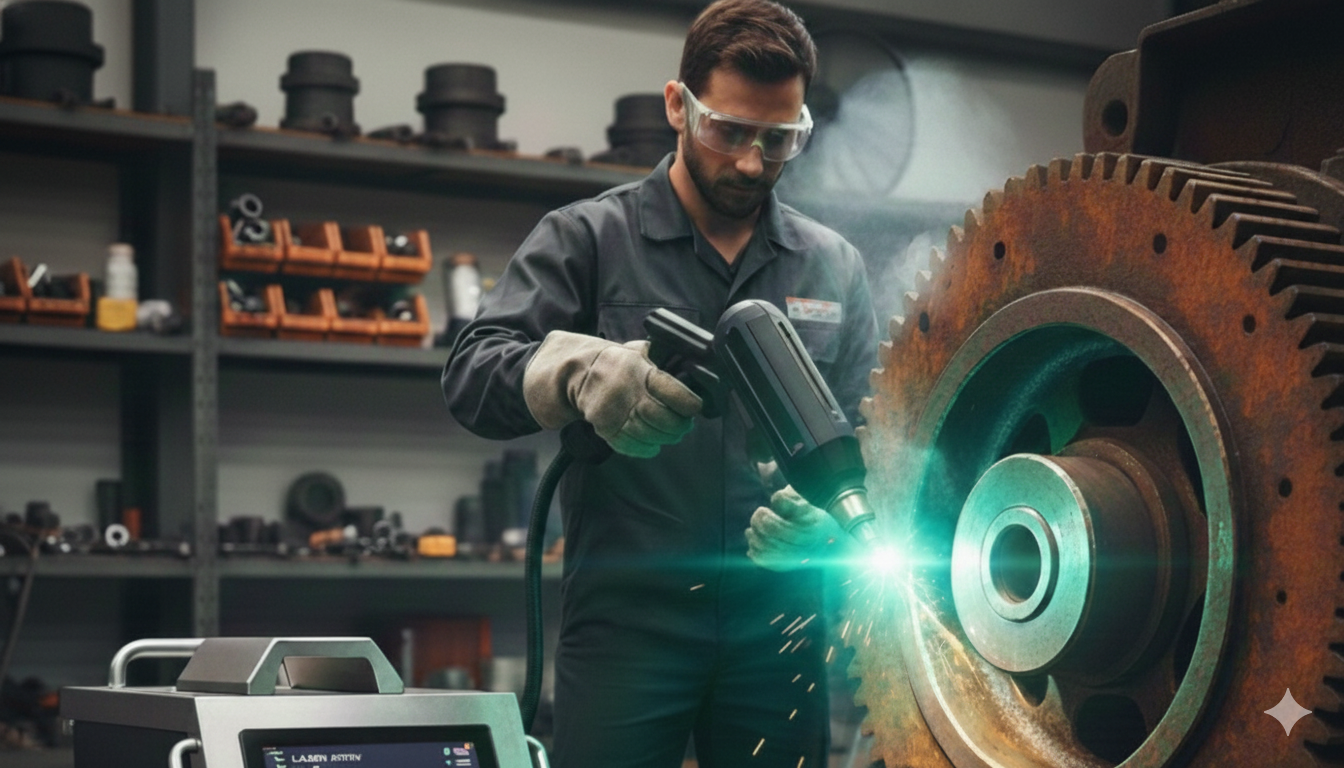
If you have ever tried to look up the laser cleaning machine price, you already know the internet is full of vague numbers, sales fluff, and people who refuse to just give you real answers. So let’s fix that.
Call Now
The cost of a laser cleaning machine is a combination of power, build quality, service and, simply, what you want it to do. However, there are also clear ranges, and once you understand each aspect of course, the entire cost picture becomes considerably easier to manage.
This guide breaks everything down so you can compare the market, avoid hype, and make a smart decision for your business.
This is the biggest variable. A 100W machine is enough for light rust or small area cleaning. A 1000W unit can strip thick rust, coatings, paint, and scale in seconds. Time saved becomes money saved, which is why many businesses choose higher power.
Cheaper machines usually use unbranded or low tier laser sources. Reliable machines often use well known suppliers or custom engineered builds. A stable laser source means consistent beam quality, longer life, and fewer breakdowns.
Laser rust removal generates heat. High power machines require strong cooling. Cheaper models use weaker coolers which often leads to downtime. Better machines use industrial grade cooling systems.
The optics, the beam delivery, and the safety systems can change the price dramatically. A safe machine should always have:
If the price seems too low to be real, it usually means these elements were skipped.
A laser cleaning machine is not a throwaway purchase. The difference between a low cost import and a well engineered system shows up in durability, stability, and service support. Stable machines cost more upfront but save money in the long run.
One major reason businesses hesitate is the upfront price. This is where Laser Clean Pro’s financing partner makes a real difference.
You get:
Instead of dropping 20,000 to 60,000 USD at once, financing spreads it out so the machine can generate revenue while you pay it off. Many clients add laser cleaning to their service list within days and start covering their monthly cost immediately.
In other words, the real cost becomes manageable cash flow instead of one large hit to your budget.
If you deal with thin surface rust, delicate parts, or small components, a 100W to 200W machine works well.
If you remove thick scale, heavy rust, paint, or coatings on large metal surfaces, you will need 500W or more.
Choosing based solely on price usually costs more later because the wrong wattage slows down work or fails to clean properly.
Time is a hidden cost. A low watt unit may work, but if your team spends hours on a job that should take minutes, you lose money on labor. Most businesses eventually upgrade for this reason.
Daily use requires a stable, well built machine. Occasional use may allow you to choose a lighter option, but only if the work volume is low.
A good laser cleaning machine is only half the investment. The service behind it is the other half. Businesses that choose the cheapest option often get stuck with no training, no repairs, and no help when something fails.
Laser Clean Pro positions itself for buyers who need real support, training, and guidance, not just a shipping label.
The best value is not the lowest laser cleaning machine price. The best value is the machine that cleans at the speed you need, stays stable under constant use, and comes with proper support.
If you are running a professional service or want to add laser cleaning as a high margin offering, you should focus on:
A machine that costs a little more upfront but cleans twice as fast often pays for itself far quicker.
The rust removal laser price varies, but once you understand the factors behind the pricing, choosing the right machine becomes easier. You want a machine that saves you time, keeps your work clean, reduces consumables, and helps you grow your business.
Laser Clean Pro’s financing program makes that step possible without draining your capital. You get the machine now, put it to work, and let the revenue cover the payments.
If you want a clear breakdown of which machine fits your workload, the team at Laser Clean Pro can match a system to your exact needs.
There is no single price for a rust removal laser. Systems vary by laser type, power, cooling configuration, portability, and intended application. A pulsed system designed for detailed restoration work has different capabilities from a high-power Continuous Wave machine built for heavy corrosion and large surfaces. The right choice should start with the type of rust removal work you need to perform.
Yes. Laser rust removal uses concentrated laser energy to break down corrosion without physically abrading the underlying metal. It can be used on applications such as equipment maintenance, structural steel, fabricated components, automotive restoration, and surface preparation. Results depend on the metal, condition and thickness of the corrosion, laser power, settings, and operator technique.
A laser rust removal gun is part of a complete laser cleaning system, so its cost should not be evaluated separately from the machine. The overall investment depends on factors such as laser type, power output, cooling system, controls, and included equipment and support. When comparing systems, consider what you need the equipment to accomplish rather than choosing based on the handheld gun alone.
There is no single best laser machine for every rust removal application. A pulsed laser can be a strong choice when precision and surface control matter, while a Continuous Wave system can be better suited to heavy corrosion and larger surfaces where throughput is important. Your material, rust condition, surface area, mobility requirements, and expected workload should determine the appropriate system.
There is no standard hourly cost for laser rust removal. A service provider may base pricing on project requirements rather than simply charging by the hour. Equipment owners also need to consider more than electricity consumption, including labor, maintenance, consumables, equipment utilization, and the time required to complete the job. For a service business, the more useful calculation is the total cost of completing a job and the revenue that job can generate.