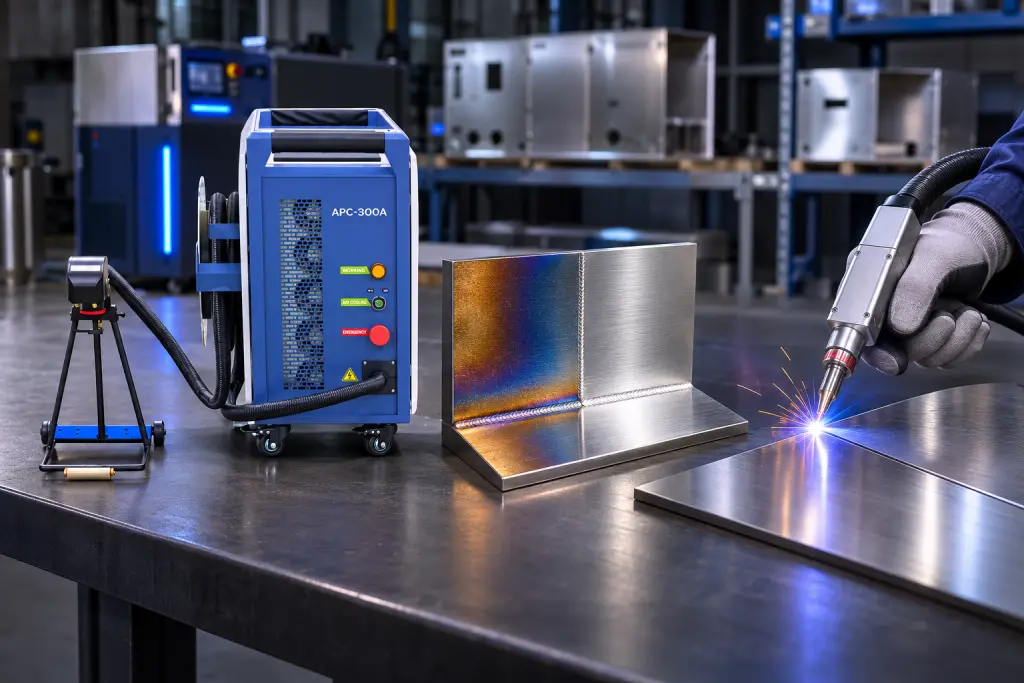
Fiber laser welding is a metal-joining process in which a laser, generated inside an optical fiber doped with ytterbium (a rare-earth element), melts a small spot of metal at the joint. The molten metal cools and fuses the two parts into one weld. "Fiber optic laser welding" is the same process under a different name.
For a shop, the practical appeal is speed and low heat. The beam is so concentrated that the heat-affected zone (HAZ), the band of metal around the weld that gets hot but does not melt, stays narrow. A narrow HAZ means less warping, so there is less straightening, grinding, and polishing after the weld.
The trade-off is preparation. The parts must meet with little or no gap, and the metal must be clean. A shop that cuts parts accurately and keeps its joints clean gets the best results from the process.
A fiber laser makes a weld in four steps:
Because the beam travels through a flexible cable, the welding head can sit on a handheld torch or on a robot arm. That is a big reason the process works in both small repair shops and production lines.
In keyhole welding, the beam is intense enough to open a narrow vapor channel, the keyhole, that carries heat deep into the joint. This creates a deep, narrow weld. In Amada Weld Tech's technical paper (2024), a 500 W fiber laser welded a tightly fitted joint of steel up to 0.08 inch thick.
Conduction welding uses a wider, gentler beam and no keyhole. It is stable, tolerates small fit-up changes better, and suits thin, cosmetic seams.
Shielding gas, such as argon, flows over the molten metal to keep air away. A wire feeder adds filler metal, which helps with gaps and solidification cracking. The trade-off is speed: cold filler wire generally cuts welding speed by 10% to 20% for the same laser power, because the laser also has to melt the wire (TWI, 2016).
A fiber laser welding machine comes in four common formats. Choose by your part mix and volume, not wattage.
These are general formats, and vendors can name them differently. Every format shares the same core parts- a laser source with pump diodes, a delivery fiber, a welding head, a controller, and cooling. A laser fiber welder may also carry a wire feeder and fume extraction.
Continuous wave (CW) lasers provide steady heat input that penetrates deeply, so they suit thicker material. Pulsed lasers keep the HAZ smaller and reduce distortion risk, which helps with thin material and very small parts Xometry, updated May 2025. Neither is better in every case, so match the laser to the part.
A single-mode beam is narrow and intense and can focus to a spot as small as 10 microns. That suits very close-fitting joints and high-speed lap welds. A multimode beam is wider and flatter, melts more base metal, and tolerates gaps better. Amada Weld Tech says joint alignment generally needs a spot of at least 200 microns, which is why multimode is common for welding (updated August 2023). In plain terms, the more your parts vary in fit, the more a wider beam helps.
The payoff comes after the weld, in less straightening, grinding, and rework. For a service business, that time is often what separates a profitable job from a marginal one.
Laser welding is generally faster than MIG, particularly on thinner materials Xometry. Close focus gives highly localized heating and a smaller HAZ, while MIG beads tend to be larger because the heat spreads wider. Laser welding also leaves near-zero spatter, while MIG can produce more spatter and more cleanup. On visible seams, such as stainless equipment that ships to a customer, that difference can cut the polishing a part needs before delivery.
The process handles stainless steel, carbon steel, aluminum, and copper, with the right settings for reflective metals. Since a controller sets the laser, robots can also repeat the same weld part after part, which suits shops with recurring production work.
Fiber lasers deliver the beam through a flexible fiber optic cable, which enables handheld guns and robot-mounted heads. The wavelengths also differ:
Sources: Amada Weld Tech (2024), Xometry (updated May 2025)
The melt pool is tiny, so anything on the joint matters. In aluminum, hydrogen trapped in the surface oxide layer and in oil and grease can dissolve in the melt and come out as porosity, small voids inside the weld. On steel, the joint should also be free of rust, mill scale, and paint.
Four common ways to prepare a joint:
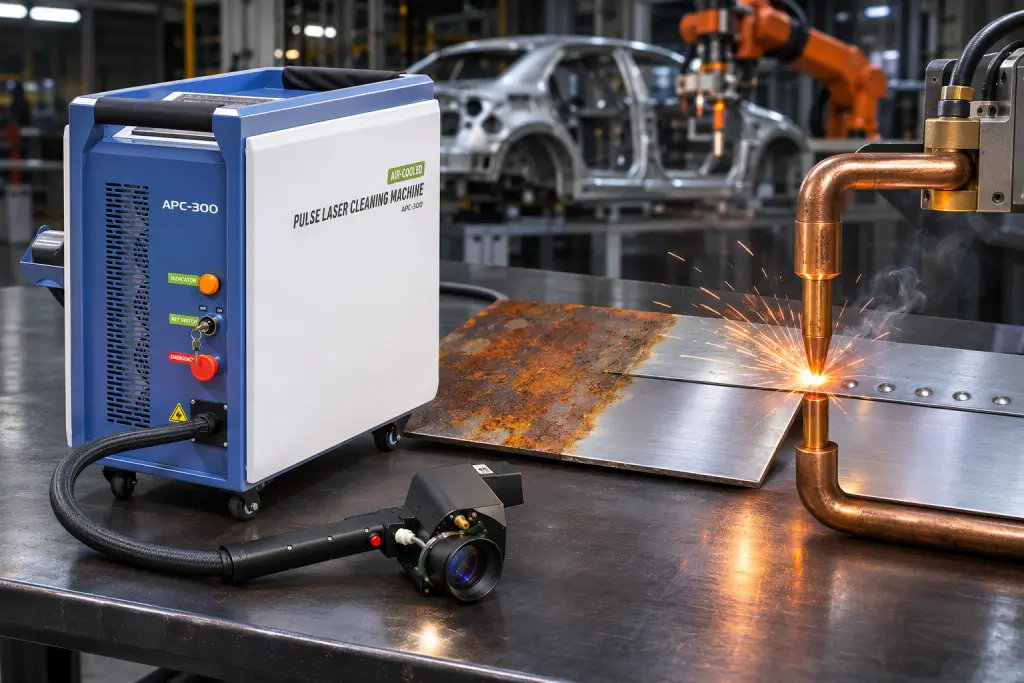
A laser cleaner can strip the joint to bare metal right before welding, without blasting media, water, or chemicals. It has limits. The equipment adds cost and requires operator training, and Li note that cleaning can be less effective before welds on thick-section aluminum. To compare equipment, see our guide to laser metal cleaning machines
Laser Clean Pro's lineup covers this work. The LCP-300P-L and LCP-500P-L are mobile, air-cooled pulsed units suited to weld prep on thin or finished parts and to post-weld cleaning where heat input must stay low. The LCP-1500C-T is a facility-based, air-cooled continuous wave machine for heavy rust and mill scale on large structural parts, where speed matters more than minimizing heat. For a fabrication shop or service contractor, a pulsed unit also handles restoration and detail cleaning, which helps keep the machine busy between weld-prep jobs.
Welding stainless can leave heat tint, a colored oxide film that lowers corrosion resistance (CORONA project, Belgian Welding Institute, 2020). Pickling with strong acids is the usual fix. Laser cleaning is a listed alternative and can remove tint without chemicals. For corrosion-critical parts, check your specification before changing the finishing step.
Sources: Xometry (updated Nov 2025), TWI (2016), Rafael Guerrero, The Fabricator (2023).
TIG is often used on stainless. Pulsing the arc lowers heat input and can reduce distortion, and faster travel limits how far heat spreads.
Choose a laser for thin sheet, visible seams, and repeat welds, where finishing time is the real cost. Stay with MIG or TIG for thick sections and loose joints. For process basics, see what laser welding is.
Fiber laser welding is commonly used where distortion or finishing time costs money.
Sources: Xometry (June 2025), Amada Weld Tech (2024).
Prices vary too widely to quote one number, and any figure you find online depends on the setup behind it. These factors move the price: power level, laser source brand, cooling method, format, wire feeder, training, and safety gear. When you compare vendors, ask each one to quote the same configuration.
Running cost is easier to estimate. Add up four hourly costs:
Ask about support too. Amada Weld Tech notes that the laser source has no internal consumables but usually cannot be repaired in the field, so a failure means a manufacturer repair.
Surface prep belongs in the same calculation. If a shop spends hours grinding joints and polishing seams, the labor on those steps affects the cost per part as much as the welder does.
Choose it when you mostly weld thin sheet, need visible seams, or repeat the same welds, and finishing takes longer than welding. Stay with MIG or TIG when you weld thick sections, deal with loose fit-up, or run a low-volume shop where skilled welders already work efficiently.
The limits are real. Aluminum and copper reflect the beam and need the right system and settings. The upfront cost is relatively high compared with traditional welding (Xometry, 2025), and operators need training. Xometry says laser welding takes extensive training and experience to run and maintain (updated Nov 2025).
If rust, scale, or heat tint is slowing your work down, laser cleaning is often the simplest place to start, whether or not you ever buy a laser welder. Laser Clean Pro offers one-on-one consultations where our team shares videos of our machines cleaning a range of surfaces, focused on your materials and contaminants. Every machine comes with start-up videos, settings guides, and direct access to our team. Talk to an expert to find out which model fits your work.
Open-beam welding lasers are generally Class 4. The beam is hazardous to eyes and skin, directly or by reflection, and can start fires (OSHA Technical Manual). Use eyewear rated for your laser's wavelength, a controlled work area, and fume extraction.
OSHA has no comprehensive laser standard. It cites employers under the General Duty Clause and points to ANSI Z136.1, while product classes follow IEC 60825-1.
How much does it cost per hour to use a fiber laser?
It depends on your machine and local rates, so use a formula, not a guess. Add electricity (rated input kW × your $/kWh), shielding gas, lens and nozzle replacements, and maintenance and filters, each converted to an hourly figure.
Is fiber laser welding good?
Yes, for the right work. It performs well on thin material, visible seams, and repeat welds because it keeps heat low and reduces finishing. It is a weaker fit for thick sections and loose-fitting joints, where MIG or TIG usually works better.
What is fiber laser welding used for? It is used in fabrication and repair, including mold and die work, as well as sheet metal and stainless fabrication, automotive parts and battery welds, electronics, medical implants and devices, and aerospace structures. Jobs where distortion or finishing time costs money are good candidates.
What is the fiber laser welding process?
A pumped, ytterbium-doped fiber produces the beam, and a cable carries it to the head. The head focuses it to melt a small spot at the joint, and shielding gas protects the pool as it hardens. The weld forms as the metal cools.
What is a fiber laser welding machine?
It is a welding system built around a fiber laser source. It also includes a delivery fiber, welding head, controller, and cooling, and comes as a handheld unit, workstation, or robotic system. Some add a wire feeder.
How much does a fiber laser welding machine cost?
It depends on power, laser source, cooling, format, wire feeder, and included training and support. Ask each vendor to quote the same configuration, then add running costs before you compare.
Is fiber optic laser welding the same as fiber laser welding?
Yes. Both names describe the same process: a laser generated in a doped optical fiber melts metal at the joint. "Fiber optic laser welding" is just the less common name.
Do you need to clean metal before fiber laser welding?
Yes. Oil, grease, and oxide on the joint can trap hydrogen and cause porosity, especially in aluminum. Abrasion, chemicals, solvents, or laser metal cleaning machines can prepare the joint. On steel, the joint should also be free of rust, mill scale, and paint.
What metals can fiber laser welding join?
Common metals include stainless steel, carbon steel, aluminum, and copper. Aluminum and copper reflect the beam, so they need the right system and settings.