Spot welding, also called resistance spot welding, joins two or more metal sheets without adding filler metal. TWI classifies it as a resistance welding process, where pressure and the heat from an electric current do the joining. Spot welding comes down to three inputs- electrode force, current, and time.
The heat comes from resistance. Metal pushes back against the current, and that push turns electrical energy into heat where the sheets touch. The small pool of molten metal cools into the weld nugget, the solid fused zone that holds the sheets together. So what is a spot weld? It's that one round fused spot, not a bead or a seam.
If we have to define spot welding against continuous welding, it would be that a continuous weld runs along the joint, while spot welding joins the sheets at separate points. The nugget grows from the sheets themselves, so standard resistance spot welding needs no filler metal.
The whole cycle takes under a second in most production work, according to researchers at TU Dresden. It runs in four steps- clamp, apply current, form the nugget, then hold and cool.
The two sheets overlap at the joint. Opposing electrodes close on them and squeeze, and the force builds to its set value before any current flows. Good contact keeps the current focused where the weld should form.
A high current flows through the electrodes and both sheets for a short, controlled time. The electrodes are copper alloy because copper conducts electricity and heat well, so the heat builds in the sheets instead of the tips (TWI). The weld forms between the sheets because contact there resists current more than the contact between each electrode and its sheet.
The heat melts a small area between the sheets. That molten area is the weld nugget, and it forms inside the joint, not on the surface (AWS). Current, resistance, and time set how much heat you get. TWI gives the relationship as Q = I²Rt, so heat rises with the square of the current. A small change in current makes a big difference to nugget size.
The current stops, but the electrodes keep squeezing. This is the hold time. The molten nugget cools and solidifies under pressure, and the sheets are permanently joined. Water cooling inside the electrodes keeps the tips from overheating.
A spot welding machine has six main parts, and each one controls part of the weld:
Electrode shape, alignment, and condition affect every weld. As tips wear, their contact area grows, and the current spreads out, so nuggets shrink. A 2024 study from Politecnico di Torino found that electrode wear strongly affects weld quality.
How well a metal spot welds depends on how it conducts electricity and heat, its thickness, its surface, and what your machine can deliver. Settings that work on one metal cannot carry over to another.
Low-carbon steel is the easiest to spot weld and the most common in sheet-metal production. It resists current more than copper and carries heat away more slowly, so heat builds in the steel rather than in the electrodes (TWI). Steels with a carbon equivalent above 0.4 can form hard, brittle welds that crack.
Stainless steel is spot welded too, including austenitic and ferritic grades. Its electrical and thermal properties differ from mild steel, so the weld schedule and electrode needs differ as well. Start with the steelmaker's or machine maker's guidance for your grade and thickness, then confirm with test welds.
Aluminum conducts heat and electricity so well that spot welding it takes about two to three times the current used on steel of the same thickness (TWI). Its natural oxide layer adds a second problem. A 2023 study notes that the oxide drives high temperatures at the electrode contact and speeds up electrode damage. Treat aluminum as a specialist job with tight control and frequent tip care, not a drop-in swap from steel.
Zinc-coated steel needs little more current than bare steel, and zinc alloys onto the copper tips and wears them down. Tips have to be dressed or replaced often. The same 2023 paper cites roughly 6,000 welds per electrode on uncoated steel and about 3,000 on zinc-coated steel. Nickel alloys and titanium are also commonly spot welded. Copper needs special electrodes, usually tungsten or molybdenum, because it heats about as fast as the copper tips do.
Four methods come up around spot welding. Three are resistance processes, and one uses a laser instead of electrodes:
Laser spot welding and resistance spot welding have different equipment, tooling, and training. Don't treat them as interchangeable.
Spot welding shows up wherever overlapping sheet metal is joined in volume. These are the main places it’s used.
Spot welding is the most common joining process in high-volume manufacturing lines. It has been the main way to join steel car bodies for over a century (TWI). A small passenger car carries roughly 3,000 spot welds, and a transporter up to 9,500, according to TU Dresden researchers. Robots place most of them, which is why repeatability and electrode upkeep matter so much on these lines.
Sheet-metal products such as washing machines, kitchen utensils and metal furniture rely on spot welds for the same reason: fast, repeatable joins between overlapping sheets.
Spot welding also joins small metal tabs and contacts in electronics. For batteries, a 2022 Warwick paper calls micro resistance spot welding a oftenly used method for cylindrical-cell packs, especially at low to medium volume. It describes welding a thin nickel tab to the cell. Other cell formats and volumes could need other joining methods.
TWI also lists aerospace, rail, medical equipment, and construction. Whether spot welding fits a given part depends on the material, joint design, and the quality standard the part must meet.
These are the practical reasons spot welding earns its place on production floors:
These advantages hold only while the process stays under control. A process nobody monitors drifts, and drift becomes rework. Spot welding isn't always cheaper or stronger than other methods. It's often the right fit for the right joint.
These limits decide whether spot welding fits a project:
If you can't reach both sides of the joint, or the part needs a sealed seam, look at another process first.
The table compares the four processes side by side. The notes below explain the differences that are most important when you choose a process.
Spot welding uses electrical resistance and opposing electrodes to join overlapping sheets. MIG welding uses an electric arc and a continuously fed wire electrode, and it welds from one side. That's why MIG is the usual answer when you can't reach the back of a joint. TWI notes that a MIG welder can even make a spot-type weld through a drilled hole in the top sheet.
For lap joints in sheet metal made in volume, start with spot welding. For closed assemblies or mixed joint types, start with MIG.
TIG welding uses an electric arc and a non-consumable tungsten electrode. It gives tight control and a clean finish, which suits precision work. It works on a different principle than resistance spot welding and relies more on operator skill. TIG is slow for repeated joints. Spot welding is built for them.
Resistance spot welding makes heat with current and electrodes. Laser spot welding makes heat with a beam. That changes the equipment, the tooling, the access you need, and the training. A fiber-delivered laser can ride on a robot, and TWI's case study cites minimal distortion and good appearance for its application. A laser doesn't make every joint stronger or distortion-free, and it needs its own safety program. AWS covers it in its free safety fact sheets. Our guide to what laser welding is and when it makes sense covers the laser side in more detail.
A spot welder isn't an open-arc process, but it still carries real hazards- flying sparks, spatter, electric shock, hot metal, pinch points, and fumes from coated parts (AWS). The right procedure depends on your machine, your material, and the maker's instructions. Consider this as a checklist:
In the US, OSHA's resistance welding standard covers installation by a qualified electrician, a disconnect near the machine, trained and competent operators, guarding of pinch points, shields against flying sparks, and periodic inspection with records. ANSI Z49.1:2021 gives wider welding safety guidance and includes some coverage of resistance welding.
Seven variables drive most outcomes, and changing one can affect the others.
No single setting works for every job. Start from the weld schedule your equipment or material supplier gives you, then qualify it with test welds.
Defects cost real money on a production line. The BMW MINI study calls expulsion expensive and says finding and reworking damaged parts is very time-consuming. An industry guide from electrode supplier AMPCO adds that defects rarely come from one bad setting. They come from small shifts that stack up.
Spot welding doesn't need a laser, but the surface is still included. Oil, oxide, scale, paint, and coatings change how current flows between each electrode and sheet, and between the sheets. TU Dresden researchers note that these contact resistances depend on the coating, the surface, and the electrode wear. When contact resistance shifts, heat forms in the wrong place, and you get inconsistent welds or expulsion.
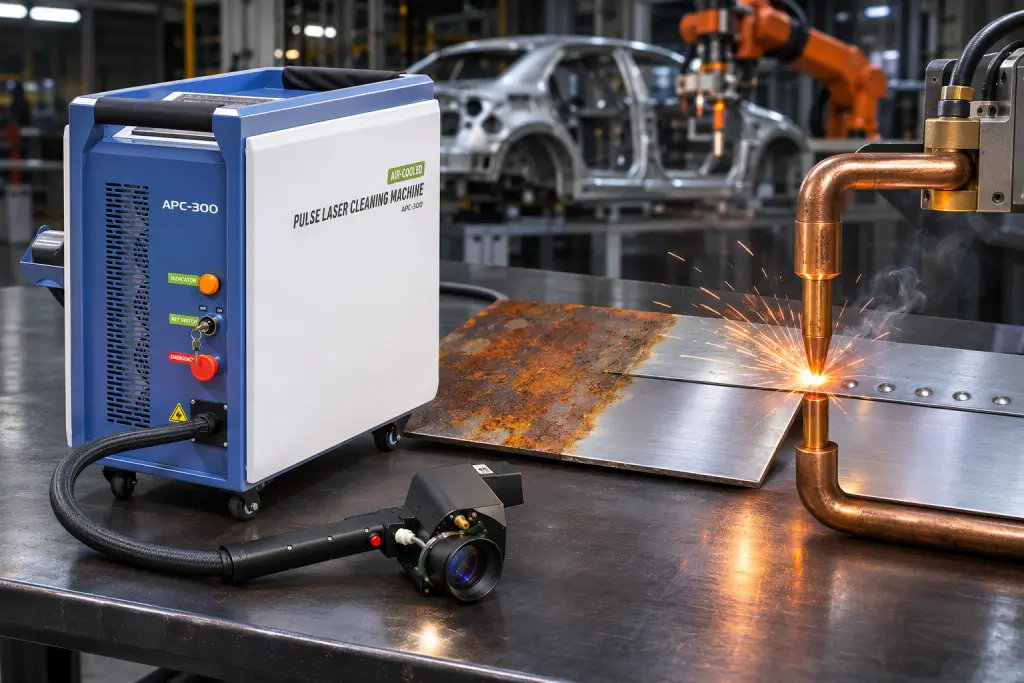
On a new sheet that matches your weld schedule, you may never need prep. It relies on repair work, refurbished parts, stored stock, and anything carrying rust, old paint, or oil. A pulse laser cleaning machine fires short bursts of laser energy that break contaminants off the metal without abrasives or chemicals.
Match the method to the metal and the contaminant. Laser cleaning has a cleaning threshold and a damage threshold. Too little energy leaves contamination behind, and too much can melt or crack the base metal. A 2022 review of aluminum cleaning describes both. Prep also changes contact conditions. On aluminum, the 2023 study above prefers chemical etching over grinding because rougher surfaces can concentrate current and wear electrodes faster. Whatever method you pick, run sample welds, because a new surface condition is a process change.
Keep the roles straight. Laser cleaning prepares the surface, and laser welding joins metal. A pulse laser cleaning machine doesn't make a resistance spot weld, and it doesn't replace correct weld settings, joint design, or inspection. Don't strip a coating the part needs, such as the zinc layer on galvanized sheet, unless the specification calls for bare metal.
Machine choice depends on the metal, the contaminant, the area, the part shape, and how much control you need. The LCP 300W Pulse Laser is a 300W pulsed fiber laser cleaner with air cooling. Its product page lists rust, oil, paint, and coatings as uses, and it describes oil removal that leaves a clean substrate ready for coating or welding. The LCP-500P-L is another pulsed, air-cooled option from Laser Clean Pro, suited to larger areas or tougher contamination. You don't need either for every spot-welding job. If you're not sure cleaning belongs in your process, talk to a spot welding expert and bring a sample part.
Not by default. Strength depends on the material, thickness, joint design, weld size and how well the process is controlled. Spot welding suits designed lap joints in sheet metal. MIG welding handles more joint types and a wider range of thicknesses. Choose the process that fits the joint, then test it.
The idea is simple: clamp, pass current, hold. Getting the same good weld every time takes the right settings, knowledge of the metal, and steady tip upkeep. Worn electrodes, poor alignment, and dirty surfaces are the usual reasons welds vary. Training and the maker's instructions shorten the learning curve.
A spot weld is a resistance-welded joint that permanently joins metal sheets. A tack weld is a short, temporary weld that holds parts in position before the final weld. TWI notes that tack welds can be removed and redone if alignment is off. Spot welds can't.
It needs access to both sides of the joint, and it suits thin material better than thick. Electrodes wear and need regular upkeep. Individual spot welds also don't make a continuous sealed joint. Seam welding does that. Process control and electrode condition decide whether welds stay consistent.
A spot welding machine joins overlapping metal sheets through resistance heating. Opposing electrodes squeeze the sheets while current passes through them, melting a small spot that cools into a weld nugget. The machine includes a power supply, electrodes, a force mechanism, a controller, and usually water cooling.
It joins overlapping sheet metal in high volume. Common uses include automotive body panels, appliances, metal furniture, electronics, and some industrial sheet-metal assemblies. TWI also lists aerospace, rail, medical equipment, and construction. Fit depends on material, joint design, and quality requirements.
Automakers use resistance spot welding to join overlapping body panels and other sheet-metal parts, usually with robots. A small passenger car carries about 3,000 spot welds. Tip condition, cooling, and fit-up all matter at that scale, because a drifting process produces rework across thousands of joints.
Want to see pulse laser cleaning on your own parts? Schedule a Demo or talk to an expert.