Laser welding joins metal using a focused beam of light as the heat source. The beam melts a small area at the joint, and the weld forms as the metal cools.
MIG and TIG welding do the same job with an electric arc, but they spread considerably more heat into the surrounding metal. As a result, laser welding tends to excel on thin material, visible seams and repeated production welds, where less heat means less warping and less polishing. MIG and TIG still hold the advantage on thicker sections and loose-fitting joints, and in shops where skilled welders already run an efficient process.
Whichever process you use, a weld is only as good as the surface it starts on. This guide covers how laser welding works, where it fits, what to weigh before switching and how laser cleaning supports both weld prep and post-weld finishing.
In the laser welding process, a focused beam is directed onto a small spot along the joint. The metal at that spot melts almost instantly, fuses and solidifies as the beam travels along the seam.
The key difference between welding with a laser and arc welding is control. Because the energy is concentrated in such a small area, very little heat spreads into the surrounding metal. Thin panels stay flatter, and seams need less cleanup afterward.
That precision comes with a tradeoff: parts must fit closely together. A gap that a MIG welder can fill with wire may be too wide for a laser to bridge, although some handheld laser welders include a wire feeder to help.
Surface condition matters for the same reason. Rust, oil, mill scale or old coatings in the weld zone can disrupt the small melt pool and cause porosity in the finished weld. A clean, consistent surface is one of the simplest ways to get consistent results.
The main types of laser welding are defined by how the laser delivers its energy.
Pulsed lasers fire in short, controlled bursts, which limits the heat that goes into each spot. They are well suited to small joints, thin material and repairs on heat-sensitive parts such as molds and dies.
Continuous wave (CW) lasers run a steady beam. That allows faster travel along long seams and deeper penetration on thicker sections, which makes CW the usual choice for production work where throughput matters.
Laser welders also come in two formats. Handheld units work much like a welding torch and suit fabrication and repair shops that handle a wide variety of jobs. Automated systems mount the laser on a robot or fixed station and are built for production lines that weld the same joint repeatedly.
The same pulsed-versus-CW distinction applies to laser cleaning machines, and it matters just as much there. We’ll come back to it in the weld-prep section.
The most common laser welding use-cases share one trait: heat control or finish quality directly affects the bottom line.
The heat-affected zone (HAZ) is the band of metal around a weld that gets hot enough to change its properties without melting. The wider the HAZ, the more likely a part is to warp, discolor or lose corrosion resistance.
On thin sheet, that difference translates directly into labor. Every warped panel needs straightening, and every heat-tinted seam needs grinding and polishing before it ships. When finishing takes longer than the weld itself, laser welding starts to make a strong business case.
Even laser-welded stainless can show some heat tint or oxide along the seam. That discoloration is where laser cleaning can replace grinding and chemical pickling, which we cover in more detail below.
Laser welding isn’t the right fit for every shop, and its limitations deserve as much attention as its strengths:
None of these limitations rule laser welding out. They simply mean the process has to match the work. A shop running MIG or TIG efficiently on thicker material often has little reason to switch.
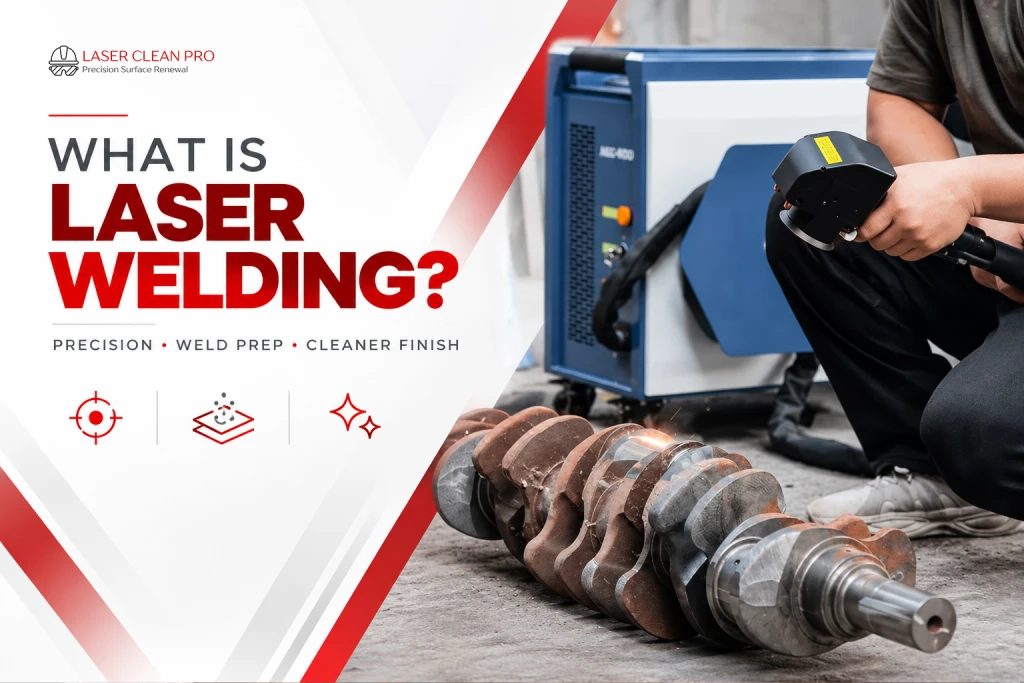
Laser welds are precise, which makes them less forgiving of a dirty joint. Rust, mill scale, oil and old coatings can trap gas in the weld pool, causing porosity, weak fusion and inconsistent results from one part to the next. The joint needs to be clean before welding starts, and on stainless, the seam often needs attention afterward as well.
Laser cleaning handles both stages. It removes contaminants with a focused beam instead of blast media, water or chemicals, and it works alongside whatever welding process a shop already uses, whether that’s laser, MIG or TIG.
Laser Clean Pro’s lineup covers both kinds of work:
For service contractors and new business owners, the pulsed models offer an added advantage: the same machine used for weld prep also handles restoration, mold cleaning and other detail work, which makes it easier to keep busy across a range of jobs.
There’s no single price for a laser welding machine. Cost depends on power level, pulsed or continuous wave operation, handheld or automated format, cooling method and the training and support included.
A compact handheld unit for occasional repair work sits at a very different investment level than a high-capacity system welding stainless enclosures every day or an automated cell built into a production line. The gap reflects the workload each one is designed for, not wattage alone.
Operating costs matter too. Power, consumables, maintenance and training all add up, so weigh them against how often the machine will actually be running. Surface prep belongs in the same calculation. If a shop spends hours grinding joints and polishing seams, a laser cleaner can lower the cost per part whether or not the shop ever buys a laser welder.
The right process depends on the parts on your bench, not the reputation of the technology:
Once the laser welding basics are clear, the decision usually comes down to how much time your shop spends preparing joints and finishing welds, and how much of that time a better process could recover.
If rust, scale or heat tint is slowing your work down, laser cleaning is often the simplest place to start. Laser Clean Pro offers one-on-one consultations where our team shares videos of our machines cleaning a range of surfaces, tailored to your materials and contaminants. We’ll help you determine whether the LCP-300P-L, LCP-500P-L or another model fits your process. Every machine comes with start-up videos, settings guides and direct access to our team, and financing is available through our financing partner.
The main drawbacks are a higher upfront cost, tight fit-up requirements and greater sensitivity to surface contamination. Reflective metals such as aluminum and copper need the right system and settings, and operators need system-specific training and proper laser safety controls.
A focused laser beam melts a small area of metal at the joint, which fuses and solidifies as the beam travels along the seam. Because the heat stays concentrated, the surrounding metal is far less affected than with arc welding.
For thin material and visible seams, laser welding often produces cleaner results with less distortion. For thicker sections, loose joints or low-volume work, TIG can still be the better fit.
It depends on power level, format, cooling method and the training and support included. Compact handheld units require a lower investment than high-capacity or automated production systems.
Yes. Rust, oil, mill scale and coatings at the joint can cause porosity and weak welds. Laser cleaning prepares the surface without media or chemicals, and pulsed models such as the LCP-300P-L and LCP-500P-L can also remove heat tint after welding.
Yes. Laser cleaning removes heat tint and surface oxide from stainless welds without abrasives or pickling chemicals, so the surrounding finish stays intact. Pulsed models such as the LCP-300P-L and LCP-500P-L are well suited to this work because they keep heat input low on thin and visible parts. Because results depend on settings, Laser Clean Pro provides settings guides and direct access to our team to help you get the right finish on your material.