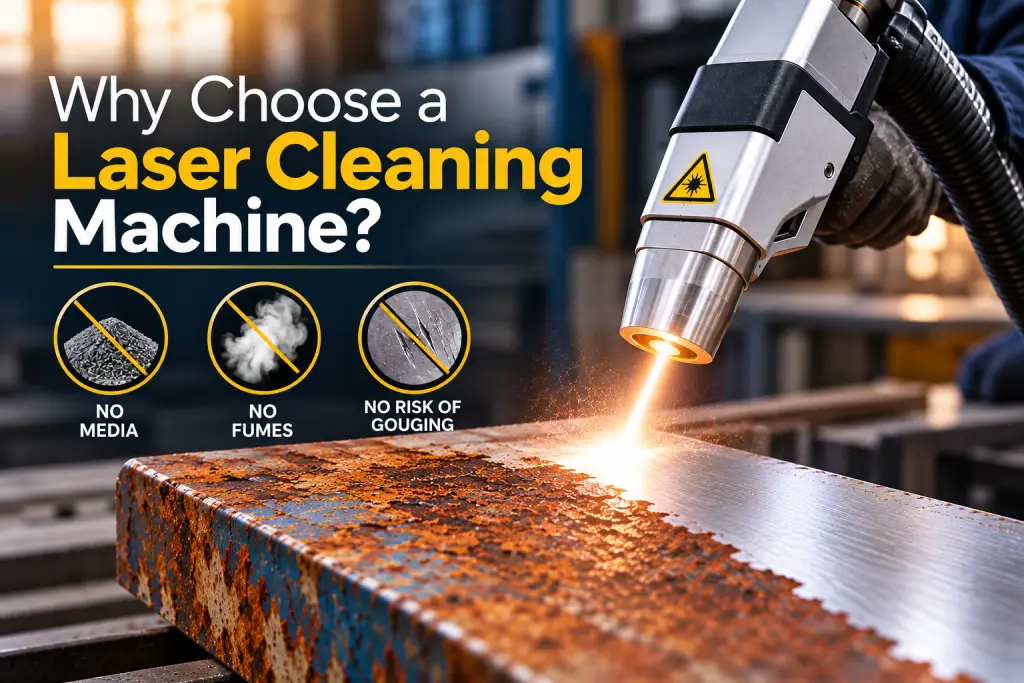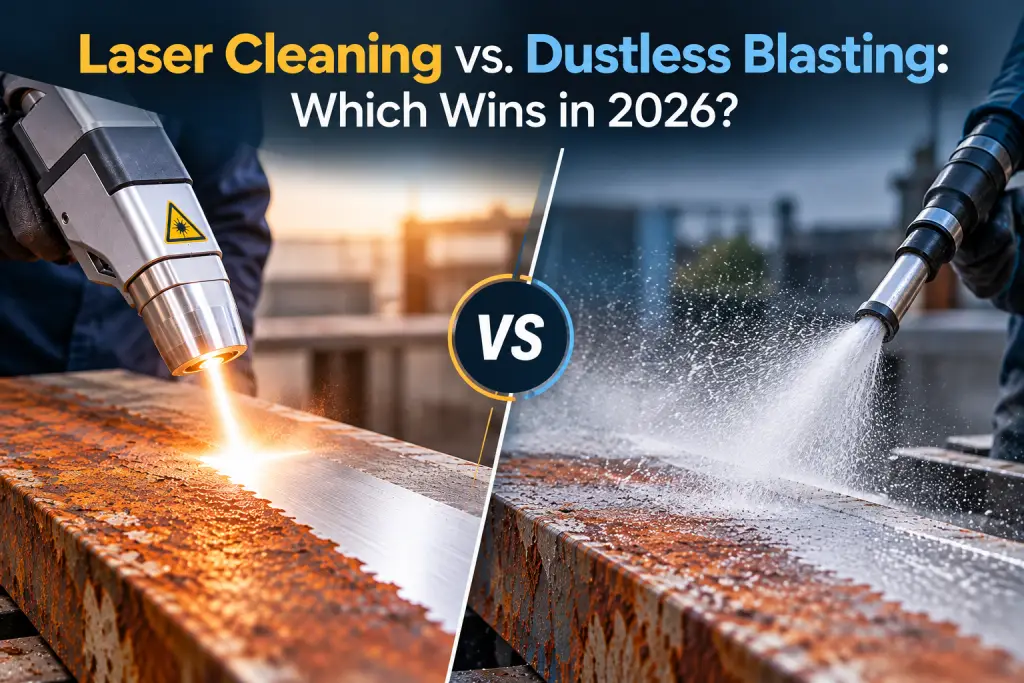
Laser cleaning uses light to vaporize rust, paint, and coatings with zero media involved. Dustless blasting uses pressurized water and abrasive to strip and profile a surface at the same time.
Laser cleaning tends to win on precision and delicate materials, while dustless blasting tends to win on speed, thick coatings, and a lower equipment cost to get started. Here's how each method actually works, and where one makes more sense than the other.
Laser cleaning, sometimes called laser blasting or laser ablation, uses pulsed light to strip rust, paint, oil, and coatings off a surface, without media, water, or chemicals of any kind.
The beam works because contaminants absorb laser energy far more readily than the base material underneath. Rust and paint break apart and lift away, while metal like steel or aluminum reflects most of the energy and stays intact.
That's what makes the process precise enough for delicate parts and controllable enough for heavy structural work, just with different power settings. And it's also why laser cleaning tends to produce fewer redo jobs than methods that are harder to control near sensitive surfaces.
Fiber laser cleaning machine
Dustless blasting combines pressurized water with recycled abrasive media to strip coatings and profile a surface in one pass. The water suppresses dust, which makes it a common choice for outdoor jobs where airborne particulate is a concern.
It's a wet process, though, which means wastewater and spent media need to be managed and disposed of after each job.
Surface profile refers to the texture a method leaves behind, something coatings or paint need to grip properly on a re-application.
Laser cleaning isn't a direct replacement for sandblasting in every scenario. It's often the stronger choice for precision, delicate substrates, and jobs where surface profiling isn't needed. Sandblasting-style methods still lead on raw speed across large, heavily coated areas.
Laser cleaning isn't the right call for every job, and knowing where it falls short matters as much as knowing where it excels:
None of these rules laser cleaning out. Only the machine and power level need to match the actual work.
Dustless blasting comes with its own set of ongoing costs and maintenance demands, ones that become obvious once a crew is running it day after day:
Rather than a fixed price range, laser cleaning machine cost comes down to a handful of factors: laser type (pulsed vs. continuous wave), power level, cooling system, portability, and the training and support included with the purchase.
An entry-level handheld unit built for detail work and mobile jobs sits at a different investment level than a high-power industrial system built for heavy structural cleaning.
And the gap between them is about the jobs each one is designed to handle, not the wattage alone. Financing and leasing options are available to both new entrepreneurs and established service companies, which lowers the barrier to entry considerably.
Because dustless blasting rigs cost less to acquire but carry ongoing media and water expenses, the two methods often even out differently depending on job volume.
A shop with frequent cleaning work tends to see the lack of consumables pay off faster, while occasional or one-off jobs may lean more toward the lower entry cost of blasting.
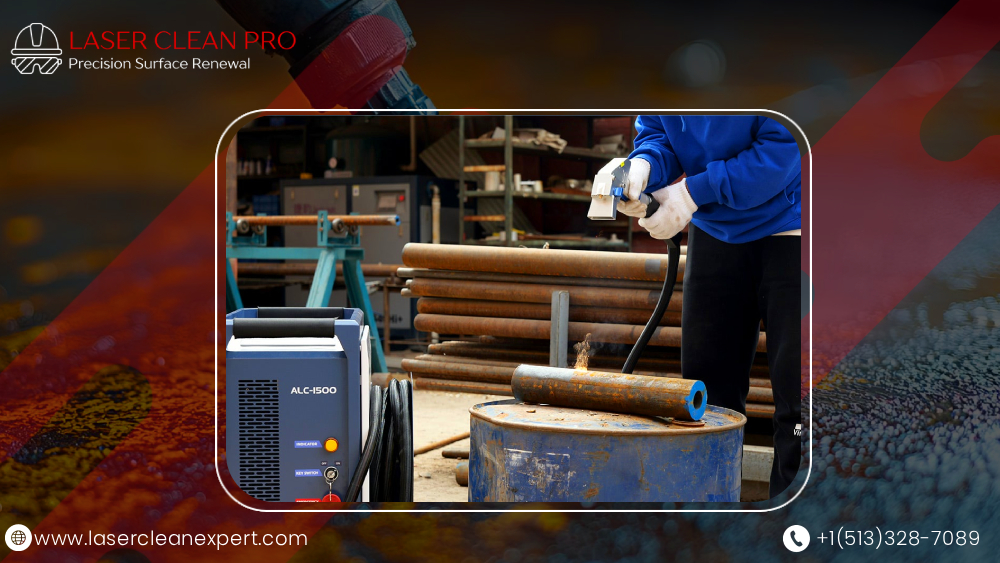
Between a full industrial laser system and a dustless blasting rig sits a middle option that often gets overlooked: the hand-held laser rust remover. These units cost less than high-power industrial systems while still eliminating media and water.
For restoration shops, auto detailers, and contractors testing laser cleaning as a new service line, a handheld unit offers a lower-cost way to get started without committing to industrial-scale equipment.
Laser Clean Pro offers handheld and compact systems built specifically for operators entering laser cleaning as a new or additional service, along with demos to help match machine type to the work.
Handheld laser rust removal machines
Choosing the right method depends on the specific task, not the overall reputation of the technology.
Once laser cleaning looks like the right direction, the next question is which power level and format fit the actual jobs on the schedule, since a machine built for detail work and one built for heavy structural cleaning solve very different problems.
Matching a method to a specific job is easier with a hands-on look at both. If you're weighing laser cleaning against your current process, scheduling a demo is a low-pressure way to see it work on your material before deciding. Comparing models is a good next step once you know which direction fits.
Higher upfront equipment cost, slower output on thick coatings, risk of heat buildup if power isn't matched to the material, and the need for a trained operator with eye protection.
Ongoing media reorder costs, wastewater and slurry disposal, weather dependency for outdoor jobs, and media clogging nozzles during active use.
Using a laser for cleaning precision work and delicate surfaces often performs better than sandblasting. For fast stripping of thick coatings across large areas, sandblasting-style methods can still have the edge.
Cost varies by rig size, media type, and job volume rather than a single fixed number, similar to how laser cleaning cost depends on power and configuration.
Yes. Operators need certified eye protection matched to the laser's wavelength, along with basic training on power settings and safe operating distance.